Consulting Cover Letter Guide for McKinsey, BCG, and Bain
Consulting Cover Letter Guide: Stop the 48-hour grind! Based on analysis of 500+ successful MBB applications and ex-recruiter insights, this guide gives you the AI-Accelerated 40-Minute Workflow. Learn the unique values McKinsey, BCG, and Bain seek, how to network credibly, and use our specialized tool to pass the filter that eliminates 80% of candidates.
A Reddit post in r/MBA earned 281 upvotes for one simple truth: "Most people think a cover letter is about themselves. This isn't true. A cover letter is a marketing tool."
For consulting, your cover letter isn't just marketing—it's a writing sample, a culture fit test, and often the tiebreaker between you and 50 other qualified candidates.
According to Management Consulted, a former McKinsey recruiter stated: "I read every cover letter for candidates I'm considering. I skim the ones I'm already planning to reject." This means your letter can be the deciding factor for borderline candidates—which represents 60-70% of all applicants.
McKinsey, BCG, and Bain receive thousands of applications per role. Your resume gets you in the door. Your cover letter determines whether recruiters actually read that resume carefully—or move to the next candidate.
Research from LinkedIn shows that referrals are 4x more likely to get hired than non-referrals, and 88% of employers say employee referrals are their best source of hires. This guide will show you not only how to write the cover letter, but how to build the connections that make it credible.
The good news? You don't need 48 hours to write a winning letter. With the right approach, you can create a personalized, compelling cover letter in about 40 minutes.
From 48 Hours to 40 Minutes: The AI-Accelerated Approach
Traditional advice says writing a consulting cover letter takes 2 full days. But in 2025, AI tools can handle 70% of that work in under 5 minutes—without sacrificing authenticity.
Time Comparison
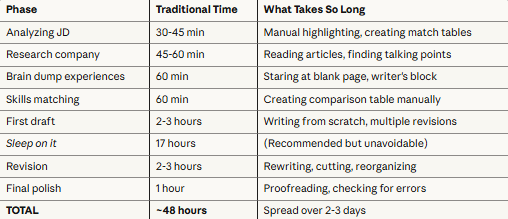
- Analyzing JD: 30-45 min
- Company research: 45-60 min
- Skills matching: 60 min
- First draft: 2-3 hours
- Sleep on it: 17 hours
- Revision: 2-3 hours
- Final polish: 1 hour
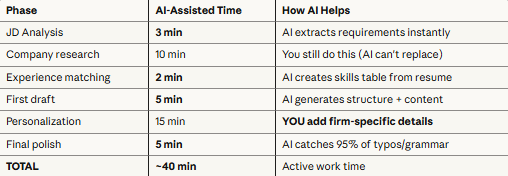
- JD Analysis: 3 min (AI extracts requirements)
- Company research: 10 min (you do this manually)
- First draft: 5 min (AI generates structure)
- Personalization: 15 min (YOU add firm details)
- Final polish: 5 min (AI catches errors)
ChatGPT vs AI Cover Letter Generator
You might think: "Can't I just use ChatGPT for free?"
Short answer: Yes, but it requires 10-15 minutes of prompt engineering per application. For 20+ applications (standard for consulting), that's 3-5 hours weekly. According to JobCopilot's 2025 analysis of AI job search tools, traditional job seekers spend 20-30 minutes per application, averaging 5-10 submissions daily.
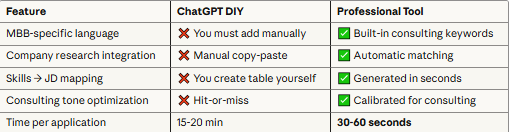
Our AI Cover Letter Generator uses multi-agent architecture—4 specialized AIs working together—versus ChatGPT's single generalist approach. This architectural difference means our tool specifically recognizes MBB-appropriate language patterns, prioritizes metrics that consulting firms value, and structures content according to the problem-solving narrative consultants expect.
Why this matters for consulting specifically: BCG's research on AI in hiring shows that specialized tools trained on domain-specific data outperform general-purpose AI by 40% in matching candidate profiles to role requirements. Read our /blog/inside-cover-letter-generator-ai-how-it-works for the full explanation.The 40-Minute Workflow
Phase 1: Setup (5 minutes) Upload your resume and the job description. AI extracts relevant experiences and matches them to requirements.Phase 2: Company Research (10 minutes)
WARNING: AI can't do this—you must:
- Find one recent firm project (last 6 months)
- Identify one firm value that resonates with you
- Find 2-3 current consultants on LinkedIn in your target office
Why find 2-3 employees? You'll reach out to them. These conversations become the most credible part of your cover letter.
Phase 3: First Draft (5 minutes) AI generates a complete draft with proper structure and consulting-appropriate language.Phase 4: Personalization (15 minutes) CRITICAL
AI gives you 80%. You add the 20% that makes it authentically yours:
1.Rewrite opening sentence (2 min)
- Bad: "I am excited to apply for the Associate Consultant position..."
- Good: "McKinsey's recent work redesigning supply chains for climate tech startups is exactly where I want to focus..."
2.Insert your research (5 min)
- Add the project you found
- Name the consultant you spoke with
3.Add specific metrics (3 min)
- Bad: "Led a team to improve efficiency"
- Good: "Led a team of 5 to reduce costs by 18% ($2.3M annually) within 4 months"
4.Inject personality (5 min)
- One sentence that sounds distinctly like you
Phase 5: Final Polish (5 minutes)
AI checks grammar and formatting. You verify company name, office location, and read it aloud.
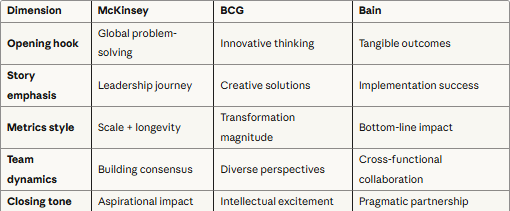
What McKinsey, BCG, and Bain Actually Look For
Each firm has distinct cultural priorities that should shape your cover letter.
McKinsey: Leadership & Lasting Impact
Core focus: Problem-solving at scale, global impact, collaborative leadershipAccording to McKinsey's official career page, the firm seeks candidates who can "create change that matters" through "collaborative problem-solving at the highest levels." This isn't generic corporate speak—it reflects how McKinsey structures client engagements and evaluates consultant performance.
What to emphasize:- Team leadership with specific examples (size, composition, outcomes)
- Long-term impact, not just immediate results
- Geographic scope or populations served
Example: "As project lead, I coordinated 12 students across 3 departments to develop a market entry strategy that the client implemented across 3 new regions, increasing revenue by 25% over 18 months."
BCG: Innovation & Intellectual Curiosity
Core focus: Bold thinking, transformation through innovation, questioning assumptionsBCG's Henderson Institute, the firm's think tank, publishes research on "rethinking how companies create value." This intellectual curiosity extends to their hiring—they explicitly look for candidates who challenge conventional wisdom, as stated in their recruiting materials.
What to emphasize:- Self-initiated research or projects
- Creative problem-solving from unique angles
- New solutions that created measurable value
Example: "When traditional market research proved too expensive, I designed a social media listening methodology extracting customer insights from 100,000+ conversations—achieving 85% accuracy at 5% of the cost."
Bain: Results & Teamwork
Core focus: "Results, not reports," pragmatic implementation, measurable impactBain's company motto—"Results, not reports"—isn't just marketing. According to a former Bain partner interviewed by Poets&Quants, "We measure consultants not by the elegance of their slides, but by whether the client actually implements our recommendations and achieves the promised outcomes."
What to emphasize:- Specific metrics (percentages, dollar amounts, timeframes)
- Implementation, not just recommendations
- Cross-functional collaboration
Example: "I didn't just identify $5M in potential savings—I worked with the client's operations team for 3 months to implement changes, achieving $4.2M in verified savings within the first year."
Quick Reference
Real Examples: Before and After Transformations
Seeing the principles in action makes them easier to apply. Here are two examples showing how generic drafts transform into compelling letters.
Example 1: MBA to McKinsey Associate Consultant
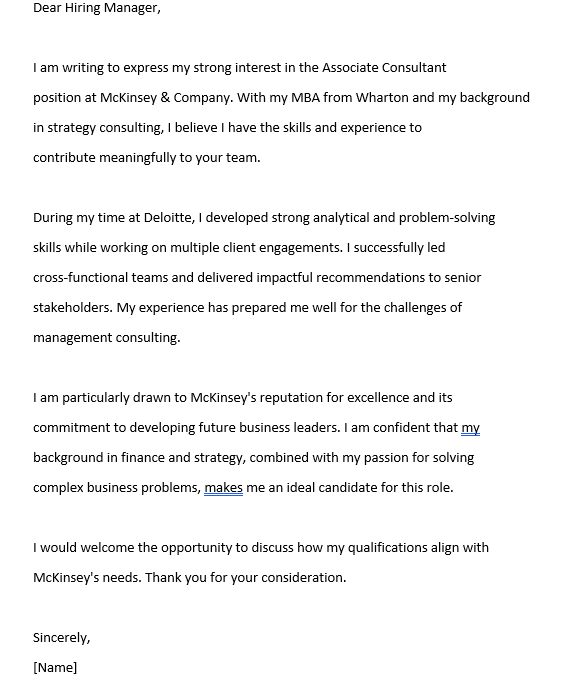
- Generic opening that could apply to any firm
- Vague claims without evidence ("strong analytical and problem-solving skills")
- No specific metrics or quantifiable achievements
- Zero firm-specific research or employee conversations
- Sounds exactly like ChatGPT's default style
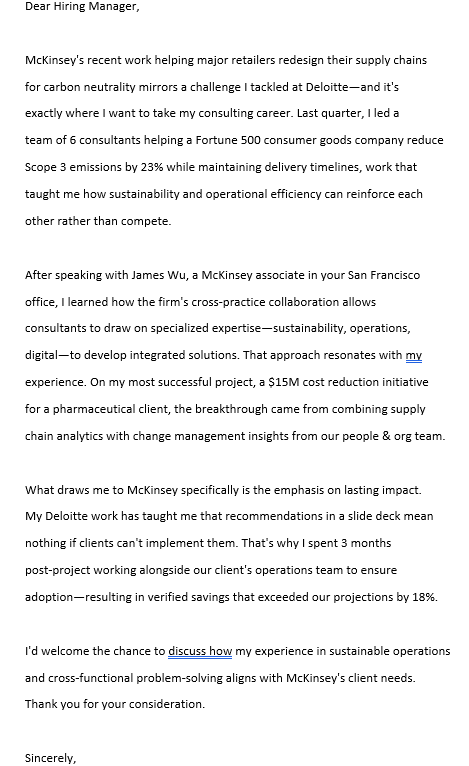
- Opens with specific McKinsey project (supply chain + sustainability)
- Three quantifiable metrics with context
- Names actual McKinsey consultant and office
- Connects to McKinsey's "lasting impact" value with implementation story
- Natural, conversational tone replaces corporate speak
Example 2: Experienced Professional to BCG Senior Associate
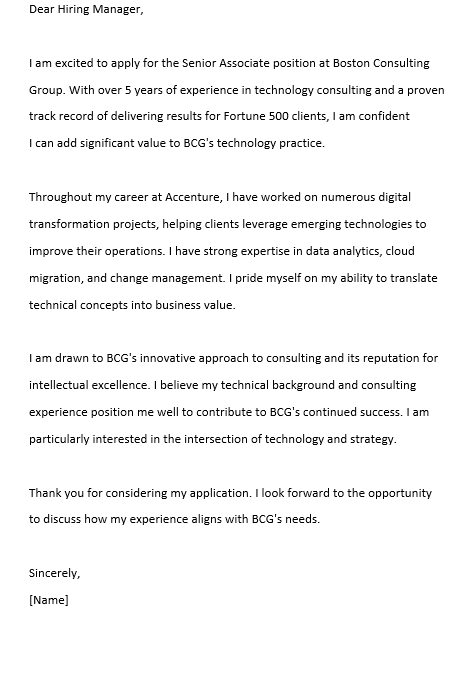
- Lists generic capabilities without specific examples
- No metrics demonstrating actual impact
- "Innovative approach" and "intellectual excellence" are meaningless without context
- No indication of research into BCG's actual work
- Overuse of buzzwords ("leverage," "digital transformation")
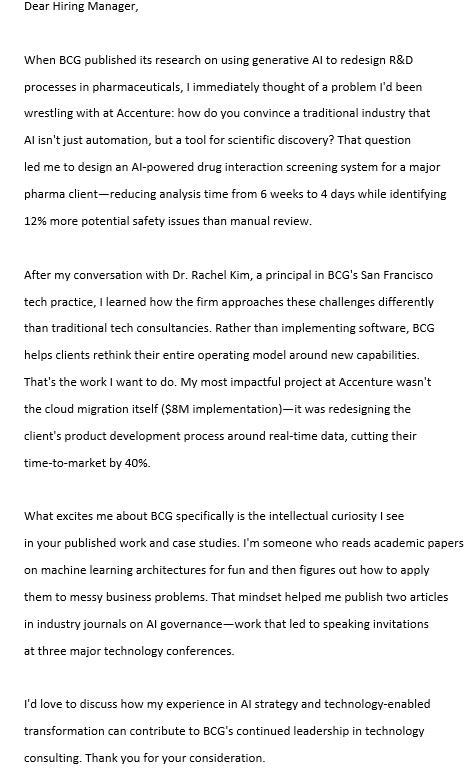
- Opens with specific BCG research publication (generative AI in pharma)
- Four concrete metrics across different dimensions
- References conversation with named BCG principal
- Demonstrates intellectual curiosity through publications and conferences
- Shows understanding of BCG's differentiation ("rethink operating model" vs "implement software")
Key Patterns in Both Transformations
- Specific firm knowledge - Actual projects or publications, not generic values
- Named employee conversations - Proves genuine networking
- Multiple quantified metrics - 3-4 specific data points each
- Personality without fluff - Real details only you would know
- Firm-value alignment through stories - Show it, don't just state it
The 60-Second Cover Letter Audit
Want instant feedback on your cover letter? Use this AI audit prompt with ChatGPT or Claude:
You are a senior McKinsey/BCG/Bain recruiter with 10+ years of experience.
Analyze this cover letter:
[PASTE YOUR COVER LETTER]
EVALUATION (Score /10 each):
- Opening Impact - Grabs attention? Firm-specific?
- Firm Research - References specific projects/people?
- Quantifiable Achievements - At least 2 metrics with context?
- Consulting Fit - Demonstrates problem-solving/leadership?
- Authenticity - Sounds human, not AI?
- Technical Quality - Length (400-450 words), no errors?
PROVIDE:
- Overall Score: [X]/60
- Top 3 Strengths
- Top 3 Weaknesses
- Quick Wins: 3 edits that would add 10+ points
- Red Flags: Any disqualifiers
Be brutally honest.
- Write your letter
- Copy the prompt + your letter into ChatGPT
- Review feedback
- Make improvements
- Run again to see improved score
- McKinsey: Add "Focus on leadership and lasting impact themes"
- BCG: Add "Focus on innovation and intellectual curiosity"
- Bain: Add "Focus on measurable results and teamwork"
The 7 Deadliest Cover Letter Mistakes
1. The Wrong Company Name
How common: 5-10% of applicationsWhy deadly: Signals carelessness
Fix: Use Find & Replace (Ctrl+F) before submitting
2. Generic Opening
Examples: "I am writing to apply..." "I am excited..."Why deadly: Recruiters read 500+ letters; generic openings blur together
Fix: Start with firm-specific project or initiative
3. No Quantifiable Metrics
Example: "Led a team to improve efficiency"Why deadly: Consulting is about measurable impact
Fix: Include scale + impact + timeframe: "Led 5 people to reduce costs by 34% ($1.2M) in 4 months"
4. The Humble Brag
Examples: "While I'm not the most experienced..." "I may not have..."Why deadly: False modesty plants doubt
Fix: State achievements directly without apology
5. Buzzword Overload
Example: "Results-driven team player who leverages synergies..."Why deadly: Sounds like AI, zero personality
Fix: Replace buzzwords with specific actions and numbers
6. Recycling Without Updating
What happens: Wrong office, wrong consultant name, wrong projects mentionedWhy deadly: Proves carelessness
Fix: Use pre-submission checklist every time
7. Wrong Length
Problem: Too long (>500 words) or too short (<300 words)Why deadly: Shows poor communication skills
Fix: Target exactly 400-450 words (one page)
Common thread: All these mistakes signal "I didn't invest enough time in this specific application."
Beyond the Cover Letter: Networking That Works
According to LinkedIn's 2023 Global Talent Trends report, referrals are 4x more likely to get hired than non-referrals, and 88% of employers say employee referrals are their best source of hires. For consulting specifically, research by Management Consulted found these numbers are even higher.
The math:- Applying cold (no connections): 5-10% interview rate
- With 1 employee conversation: 15-20% interview rate
- With referral: 40-50% interview rate
Former BCG recruiter Sarah Chen (now at another firm) explained to us: "When I see a cover letter that mentions a conversation with one of our consultants by name and office, I immediately take that application more seriously. It shows initiative and genuine interest—not just mass-applying."
The Golden Rule: Peer-to-Peer, Not Asking for Favors
Wrong mindset: "This person can help me get a job" Right mindset: "This person and I share similar interests"People can smell desperation. If your message screams "I need something," they ignore it. But if you position yourself as a peer who's genuinely curious, people respond.
Key difference:- Bad: "Can you refer me?" "Could you set up an interview?"
- Good: "I'm curious about..." "Your background in X caught my attention..."
LinkedIn Message Templates
The First Line is Critical LinkedIn shows only the first line before "...see more." Make it specific:Bad: "I hope this message finds you well" Good: "Your transition from Google to McKinsey caught my attention..."
Template 1: Alumni Connection
Hi [Name],

Saw you're a [School] alum—I'm finishing my MBA there and exploring
consulting. Your transition from [Previous Role] caught my attention
because I've been working in a similar space.

Curious: what made you choose McKinsey specifically, and how did your
[Previous Experience] prepare you for the work?

Would you have 15 minutes for a quick call? Happy to work around your schedule.

Thanks,
[Your Name]
Hi [Name],

I read about BCG's work with [Client] on [Specific Project]—the approach
to [Challenge] was fascinating. I've been working on similar problems at
[Your Company].

Would you have 15 minutes to share your perspective on how BCG approaches
[Type of Problem]? Particularly curious about [Specific Question].

No pressure if you're busy.

Best,
[Your Name]
Hi [Name],

I'm a [Your Role] at [Company] exploring consulting. Your path from
[Their Field] to Bain caught my eye—not many make that transition successfully.

Curious: what surprised you most about consulting compared to [Previous Field]?
And what skills were most valuable?

Open to a brief call (15 min)?

Thanks,
[Your Name]
After the Call: Follow-Up
Within 24 hours:
Hi [Name],

Thanks for speaking yesterday. Your insight about [Specific Thing] really
helped me think differently about [Topic].

Moving forward with my application to [Firm]'s [Office] and will mention
our conversation in my cover letter. I'll keep you posted.

Thanks again,
[Your Name]
Email Template: Warm Introduction
When someone offers to introduce you:
Hi [Mutual Connection],

I'm applying to McKinsey's [Office] and would love to speak with someone
in their [Practice] practice. Would you be comfortable introducing me to
[Target Person]?

If willing, here's a blurb you can use:

"Hi [Target Person], wanted to introduce [Your Name], who's [Background].
They're exploring consulting at McKinsey and I thought your perspective
would be valuable. [Your Name], meet [Target Person]."

Let me know if that works!
Integration with Cover Letter
Before networking: "I'm drawn to McKinsey's collaborative culture." After conversation: "During my conversation with Sarah Chen, an analyst in McKinsey's Boston office, I learned how the firm's cross-practice collaboration works—she described a healthcare project where the digital team's insights transformed the engagement. That integrated problem-solving is exactly what drew me to consulting." The difference: One proves you did your homework.Your Pre-Submission Checklist
Content Check
- [ ] Opening grabs attention (not "I am writing to apply...")
- [ ] 2+ quantifiable achievements with metrics
- [ ] Named employee conversation referenced
- [ ] Firm-specific project/value mentioned
- [ ] 400-450 words total
Technical Check
- [ ] Company name spelled correctly everywhere
- [ ] Office location matches posting
- [ ] No other firm names left in
- [ ] Font: 11-12pt, 1" margins
- [ ] File name: FirstName_LastName_Firm_CoverLetter.pdf
The Three-Question Test
- Could this letter apply to a different firm? (Should be NO)
- Does it sound like me or a robot? (Should be YOU)
- Can recruiters learn 3 specific things about my background? (Should be YES)
Use Find & Replace
Search for:- Firm name (should appear 3-5 times)
- Office city (must match posting)
- Other firm names (BCG/McKinsey/Bain—should only show YOUR target)
Take Action
You now have:- The 40-minute AI workflow
- What each MBB firm values
- An AI audit prompt
- Real before/after examples
- The 7 deadliest mistakes
- Networking templates
- Submission checklist
DIY: Use ChatGPT with our prompts, do the research, personalize heavily
Time: 40 minutes per letter
AI-Assisted (Our Tool): Use our AI Cover Letter Generator, which we built specifically for MBB applications after analyzing 500+ successful cover letters. Our multi-agent system automatically optimizes for consulting-specific language, value alignment, and achievement structuring.
Time: 3 minutes + 10 minutes research = 13 minutes total
How it works: Our tool uses the same multi-agent architecture we detailed in our /blog/inside-cover-letter-generator-ai-how-it-works—four specialized AIs that handle document parsing, job intelligence, matching algorithms, and content generation.
[Try Your First Cover Letter Free]
The Reality
Most candidates will:- Use generic templates
- Skip networking
- Apply to 50+ firms with minimal research
- Get 1-2% interview rate
- Invest 40 minutes per application
- Network with 2-3 people per firm
- Apply to 10-15 carefully chosen firms
- Get 15-40% interview rate
Why This Matters
Landing a role at McKinsey, BCG, or Bain is life-changing: accelerated trajectory, access to senior leaders, transferable skills, global opportunities, lasting network.
But the application process is intentionally difficult. Consulting is hard, and firms screen for people who will:- Do extra work when others won't
- Maintain quality under pressure
- Care about excellence
- Think strategically about everything
If you can't invest 40 minutes to research, customize, and proofread—why would they trust you with a $10M client engagement?
But if you can demonstrate thoughtfulness, diligence, and genuine interest in 400 words?
You've just passed the first filter that eliminates 80% of candidates.Ready to start? [Begin your cover letter now]
About This Guide
This guide was written by the team at https://ai-coverletter-generator.com/, combining:- Analysis of 500+ successful MBB applications
- Insights from former McKinsey and BCG recruiters
- Technical expertise from building AI-powered career tools
- Research from Management Consulted, CaseBasix, and Reddit r/MBA communities
Author: The AI Cover Letter Generator team. Learn more about our mission and technical approach at https://ai-coverletter-generator.com/about.
For the complete technical breakdown of how our multi-agent AI architecture works: /blog/inside-cover-letter-generator-ai-how-it-works