How to Write a Powerful Cover Letter With No Experience
No work experience? No problem. Learn the exact 6-step framework to write a compelling cover letter that turns your education, hobbies, and volunteer work into job offers.
The Harsh Reality Every First-Time Job Seeker Faces
You're staring at a blank document. The cursor blinks mockingly. The job posting asks for "2-3 years of experience," but this is your first real job application. Your resume feels painfully thin. You have no internships, no relevant work history, nothing that screams "hire me."
Here's what's running through your mind:"How can I write a cover letter when I have literally nothing to say?"
"Won't they just laugh at my application?"
"Everyone else probably has experience. Why would they pick me?"
If this sounds familiar, you're not alone. According to recent data, 73% of entry-level job seekers report feeling "completely unqualified" when applying for their first positions, even when they meet most of the basic requirements. This psychological barrier—the feeling that you have nothing valuable to offer—is often more damaging than the actual lack of experience.
But here's the truth that hiring managers won't openly tell you: For many entry-level positions, employers expect candidates to have little or no direct experience. What they're really looking for is potential, attitude, and transferable skills that prove you can learn quickly and contribute value.
This guide will show you exactly how to write a cover letter that turns your "lack of experience" into a compelling story about your readiness to excel in the role.
Why Your "No Experience" Is Actually an Asset (Yes, Really)
Before we dive into the how-to, let's reframe your mindset. Your lack of traditional work experience can actually be a strategic advantage:
1. You're Not Carrying Bad Habits
Employers in many industries prefer candidates without experience because you're not bringing preconceived notions or outdated practices from previous jobs. You're a blank canvas ready to be trained in their methods.
2. You Bring Fresh Perspectives
Your recent educational background means you're up-to-date with current theories, technologies, and approaches. You haven't been doing things "the old way" for years—you can offer innovative solutions.
3. You're Highly Motivated
First-time job seekers typically show higher enthusiasm and dedication than experienced candidates who might be jaded or simply looking for a paycheck. Hiring managers value this hunger to prove yourself.
4. You're More Affordable
Let's be pragmatic: entry-level candidates cost less. For small businesses and startups, hiring someone eager to learn at a lower salary point is often more valuable than hiring an expensive veteran.
The key is demonstrating these advantages clearly in your cover letter. Now let's get tactical.The 6-Step Framework for Writing a Cover Letter With No Experience
Step 1: Research Like Your Application Depends On It (Because It Does)
Most candidates skip this step, which is exactly why they fail. Before writing a single word, you need to gather intelligence:
Company Research Checklist:
- [ ] Company mission and values – Find their "About Us" page and note 2-3 values that resonate with you
- [ ] Recent news or achievements – Check their latest press releases, blog posts, or LinkedIn updates
- [ ] Company culture signals – Read employee reviews on Glassdoor (but take with a grain of salt)
- [ ] Leadership team – Who are the founders or key executives? What do they care about?
- [ ] Industry position – Are they a disruptor, an established player, or a startup?
Job Posting Analysis:
Don't just skim the job description—dissect it:
- Highlight every skill mentioned (e.g., "communication skills," "attention to detail," "Microsoft Excel")
- Identify the top 3-5 priorities – Usually found in phrases like "You will primarily be responsible for..."
- Note the tone – Is it formal and corporate, or casual and startup-like? Match this tone in your letter.
- Find the pain points – What problem is this hire solving for the company?
Step 2: Mine Your Life for Hidden "Experience"
Here's the uncomfortable truth: You do have experience—you just haven't learned to recognize it yet.
When hiring managers say they want "experience," they're not always talking about paid employment. They're looking for evidence that you've successfully used relevant skills. Here's where to find that evidence:
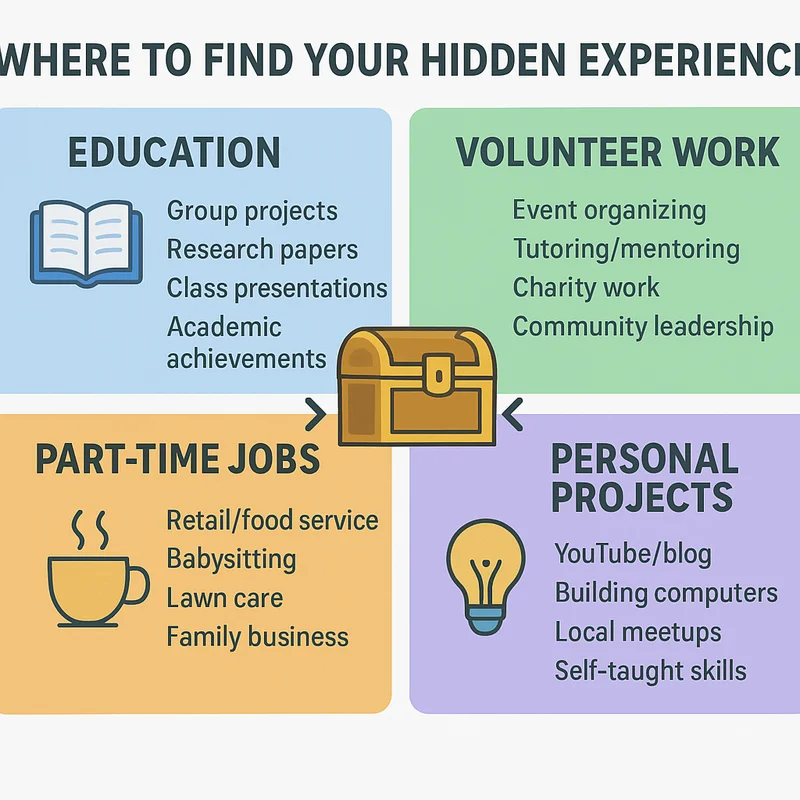
Educational Experiences:
- Group projects → Demonstrates teamwork, project management, meeting deadlines
- Research papers → Shows research skills, critical thinking, writing ability
- Class presentations → Proves public speaking and communication skills
- Academic achievements → Indicates dedication, learning ability, perseverance
- Challenging coursework → Highlights problem-solving and adaptability
Volunteer & Community Work:**
- Organizing events → Project management, coordination, leadership
- Tutoring or mentoring → Teaching, patience, communication
- Charity work → Empathy, dedication, teamwork
- Community leadership → Initiative, problem-solving, influence
Personal Projects & Hobbies:
This is where most people miss opportunities. Your hobbies often build professional skills:
- Running a YouTube channel or blog → Content creation, consistency, audience analysis
- Building computers → Technical troubleshooting, attention to detail
- Organizing local events or meetups → Event planning, networking, logistics
- Managing finances or budgets (even personal) → Financial literacy, responsibility
- Teaching yourself a new language or skill → Self-motivation, learning ability
Part-Time or "Unrelated" Jobs:
Even if your summer job was flipping burgers or stocking shelves, you developed transferable skills:
- Retail/food service → Customer service, handling complaints, working under pressure, cash handling
- Babysitting → Responsibility, problem-solving, time management, trust
- Lawn care/odd jobs → Independence, reliability, physical endurance
- Family business help → Business operations, flexibility, loyalty
Step 3: Structure Your Cover Letter for Maximum Impact
Here's the proven structure that works:
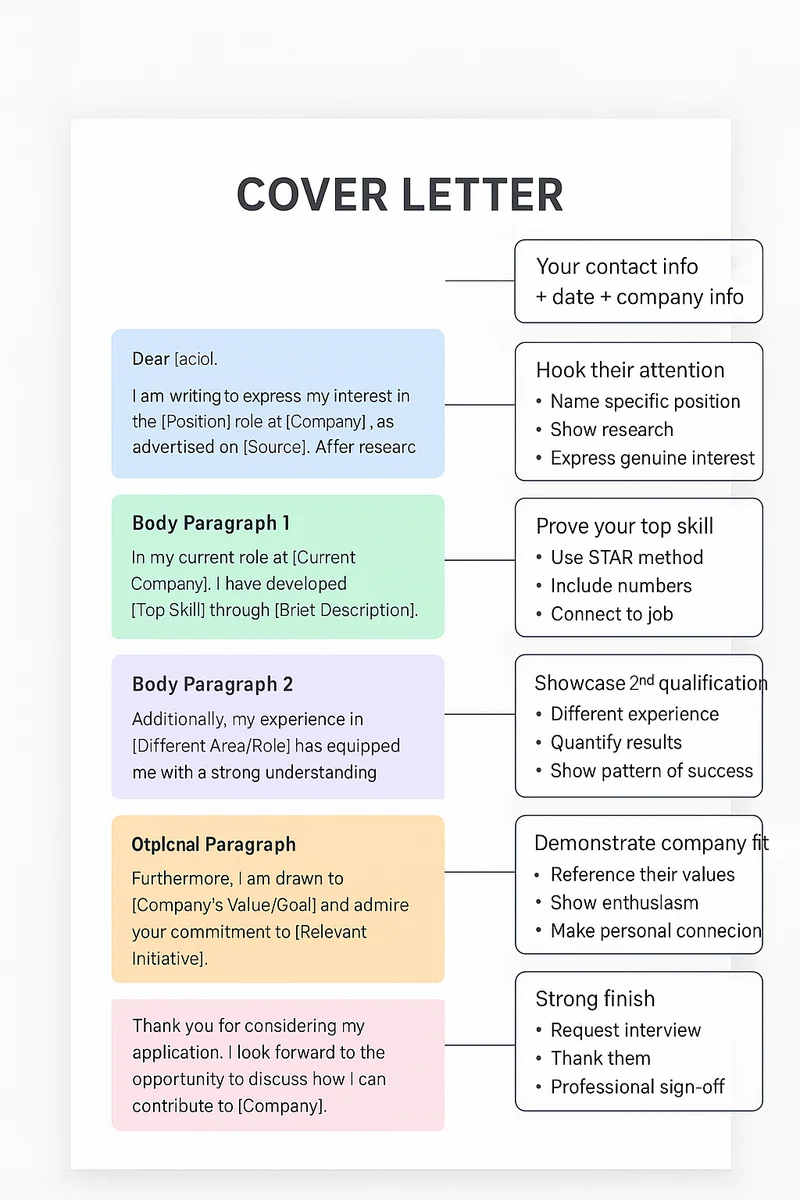
Opening Paragraph (2-3 sentences):
Your goal: Hook their attention immediately and establish credibility.
Formula:- Name the specific position you're applying for
- Briefly state your current situation (student, recent graduate, career changer)
- Express genuine enthusiasm with a specific reason
"I am writing to apply for the Marketing Coordinator position at GreenTech Solutions. As a recent graduate from the University of Texas with a degree in Communications, I was immediately drawn to your company's mission of making sustainable technology accessible to everyday consumers. Your recent campaign highlighting solar panel affordability perfectly aligns with my passion for environmental advocacy and persuasive storytelling."
Why this works:
- Specific position named
- Clear identification (recent grad)
- Shows research (mentions specific campaign)
- Makes a personal connection (environmental advocacy)
Body Paragraphs (2-3 paragraphs, 4-6 sentences each):
This is where you build your case. Each paragraph should follow this structure:
Paragraph 1: Demonstrate Your Top Relevant SkillPick the most important requirement from the job posting and prove you have it.
Formula:- State the skill
- Provide a specific example from your life
- Quantify the result when possible
- Connect it to the job
"Throughout my three years working as a barista at Starbucks, I developed exceptional customer service skills in a fast-paced environment. I regularly handled challenging situations—from resolving order mistakes to calming frustrated customers during morning rush hours—while maintaining a positive attitude. My approach led to a 4.9-star average on my personal customer feedback surveys, and I was recognized as 'Employee of the Month' twice. I'm confident these same skills will help me excel in resolving customer inquiries for TechSupport Inc."
Why this works:
- Specific situation described
- Quantifiable achievement (4.9 stars, 2x Employee of Month)
- Directly connects to target role
- Shows pattern of success, not just one-time luck
Repeat the formula with a different skill/experience.
Example (for same Customer Service role):"My academic background in psychology has given me unique insight into understanding customer behavior and motivation. In my capstone project, I researched conflict resolution techniques and discovered that empathetic listening reduces customer complaints by an average of 65%. I applied these principles during my volunteer work with the campus crisis helpline, where I successfully de-escalated over 100 emotional conversations. This combination of theoretical knowledge and practical application positions me to not only handle customer issues but to turn negative experiences into opportunities for building loyalty."Paragraph 3 (Optional): Address Company Fit & Enthusiasm
Show you're not just looking for "any job"—you specifically want this job at this company.
Example:"I'm particularly excited about TechSupport Inc.'s recent expansion into AI-powered customer support tools. As someone who has been following AI developments closely and even completed an online course in machine learning basics through Coursera, I'm eager to be part of a forward-thinking team that's revolutionizing customer service. Your company's commitment to continuous learning—evidenced by your tuition reimbursement program—aligns perfectly with my personal value of lifelong growth."
Why this works:
- References specific company initiative
- Shows proactive learning (took relevant course)
- Mentions specific company benefit (shows you read carefully)
- Makes a values-based connection
Closing Paragraph (2-3 sentences):
Your goal: Create a clear call-to-action and leave a confident final impression.
Formula:- Reaffirm your enthusiasm
- Express confidence in your ability to contribute
- Request next steps (interview/meeting)
- Thank them for their consideration
"I am excited about the opportunity to bring my customer service experience, psychological insights, and genuine passion for technology to TechSupport Inc. I would welcome the chance to discuss how my unique background can contribute to your team's success. Thank you for considering my application—I look forward to speaking with you soon."Professional Sign-Off:
Sincerely,
[Your Full Name]
[Phone Number]
[Email Address]
[LinkedIn Profile URL - optional but recommended]
Step 4: Demonstrate "Soft Skills" That Matter More Than Experience
For entry-level roles, soft skills often outweigh technical expertise. Here are the top 5 soft skills employers value—and how to prove you have them:
1. Adaptability & Learning Agility
What it means: You can quickly learn new systems, adjust to changing priorities, and thrive in unfamiliar situations.
How to demonstrate it:
"When the pandemic forced my university to shift online in March 2020, I adapted by creating a virtual study group for my calculus class. Within two weeks, I learned Zoom's breakout room features, set up a shared Google Drive for resources, and coordinated schedules across three time zones. Our group maintained a 92% average in the course despite the disruption, demonstrating my ability to problem-solve and lead during unexpected changes."
2. Communication Skills
What it means: You can clearly explain ideas, listen actively, and tailor your message to different audiences.
How to demonstrate it:
"As the social media coordinator for my college's environmental club, I managed communication across multiple stakeholders—writing casual Instagram captions for fellow students, formal email updates for faculty advisors, and persuasive grant proposals for potential donors. This experience taught me how to adjust my tone and messaging based on audience needs, a skill essential for any client-facing role."
3. Problem-Solving
What it means: You can identify issues, think critically, and develop effective solutions.
How to demonstrate it:
"During my summer internship at a local nonprofit, I noticed that volunteer no-show rates were hurting event execution. Rather than accepting this as normal, I conducted informal interviews with 15 volunteers to understand the problem. I discovered that unclear communication about time commitments was the main issue. I created a simple confirmation system using Google Forms that reduced no-shows by 60% over the next three months."
4. Initiative & Self-Motivation
What it means: You don't wait to be told what to do—you proactively seek opportunities and take action.
How to demonstrate it:
"Recognizing that my degree in biology didn't include data analysis skills increasingly required in research positions, I enrolled in a free online SQL course through Khan Academy and completed it entirely on my own time. I then volunteered to help a professor organize 10 years of field research data, applying my newly learned skills to create a database that's still used by the department today."
5. Teamwork & Collaboration
What it means: You work well with others, contribute to group success, and handle interpersonal dynamics professionally.
How to demonstrate it:
"As part of a five-person team for our senior marketing project, I encountered a significant challenge when two team members had conflicting visions for our campaign strategy. Rather than let tension derail us, I facilitated a structured meeting where each person presented their ideas with supporting data. We ultimately combined the strongest elements of both approaches, resulting in a campaign that earned an A+ and was later showcased at the university's business school showcase."The Pattern: Notice how each example follows the STAR method (Situation, Task, Action, Result). This structure gives your claims credibility.
Step 5: Use AI to Unlock Hidden Strengths in Your Background
Here's where modern technology becomes your secret weapon. One of the biggest challenges for first-time job seekers is that you don't even realize which experiences are valuable. You've been living your life—you can't see your own achievements objectively.
This is where AI-powered tools like ChatGPT can be transformative (but only when used correctly).
How AI Helps With "No Experience" Cover Letters:
1. Identifying Transferable Skills You're Blind To
AI can analyze your educational background, volunteer work, and hobbies to surface skills you didn't realize were relevant. For example:
- You mention you organized a charity bake sale → AI identifies: event planning, budget management, marketing, volunteer coordination, fundraising
- You mention playing competitive video games → AI identifies: strategic thinking, real-time decision making, teamwork, performance under pressure
- You mention taking care of younger siblings → AI identifies: responsibility, conflict resolution, time management, multitasking
You might describe something as "I helped my friend's mom with her Etsy shop," but AI can help reframe this as: "Provided e-commerce support including product photography, inventory management, and customer inquiry responses for a growing online retail business."
3. Matching Your Background to Specific Job RequirementsBy analyzing both your experiences and the job description, AI can suggest which of your stories best align with what the employer is seeking—something that would take hours of manual comparison.
Quick Example: AI-Powered Transformation
Your Original Thought:
"I don't have any marketing experience, just helped with my school's social media sometimes."
After Using AI to Extract Value:
"Managed social media content creation and posting schedule for university's sustainability club (1,200+ followers), resulting in 45% increase in event attendance over one semester. Developed understanding of audience engagement metrics and content optimization through regular A/B testing of post timing and visual styles."
See the difference? The second version:
- Quantifies your impact (1,200 followers, 45% increase)
- Uses professional terminology (audience engagement metrics, A/B testing)
- Frames the experience as legitimate work (managed, developed, optimized)
- Is still 100% truthful—just presented more strategically
The Right Way vs. Wrong Way to Use AI
WRONG: Copy-paste an AI-generated cover letter with zero personalization
- This produces generic, robotic-sounding letters that recruiters instantly recognize and reject
- Extract transferable skills from your experiences
- Get suggestions for how to describe your background professionally
- Identify which of your stories best match the job requirements
- Refine your language to be more concise and impactful
Want to Learn More About Using AI for Cover Letters?
The topic of AI-assisted cover letter writing is deep enough that we've written two comprehensive guides:
For Detailed ChatGPT Prompts and Techniques:Learn the exact ChatGPT prompts that produce quality results, why free ChatGPT has limitations, and how professional AI tools work.
→ Inside Cover Letter Generator AI: How It Works and ChatGPT Comparison For Deciding Whether You Need a Cover Letter at All:
Not sure if you should even write a cover letter for a specific job? Use our complete decision framework.
→ Do You Still Need a Cover Letter? (Based on Real Experience)
The Bottom Line: AI as Your Translation Tool
The key is to use AI as a translation tool, not a replacement for your authentic voice and genuine experiences.
Think of it this way:- You provide: The raw materials (your real experiences, genuine enthusiasm, honest assessment of your skills)
- AI helps with: Professional phrasing, identifying which experiences matter most, organizing your thoughts coherently
- You finalize: Editing for authenticity, fact-checking, ensuring it sounds like YOU
The goal isn't to let AI write your cover letter—it's to use AI to help you articulate the value you already possess but might struggle to express.
Step 6: Avoid the 7 Deadly Mistakes That Kill "No Experience" Cover Letters
Even with great content, these mistakes will get you rejected:
Mistake #1: Apologizing for Lack of Experience
NEVER write: "I know I don't have any experience, but..."
This immediately frames you as inadequate. Hiring managers for entry-level roles expect no experience. Apologizing only draws attention to what you lack.
INSTEAD write: "As a recent graduate eager to begin my career in [field], I bring [specific strength or qualification]."Mistake #2: Being Too Generic
GENERIC:
"I am a hard worker who is eager to learn and would be a great addition to your team."
This could apply to literally any job. It says nothing specific about you or the role.
SPECIFIC:"I am particularly drawn to this Content Coordinator role because of your company's focus on authentic storytelling in the outdoor recreation space—a passion I've pursued through maintaining a hiking blog with 10,000+ monthly readers for the past two years."
Mistake #3: Focusing on What the Job Will Do for You
WEAK:
"This position would give me valuable experience in the marketing field."
Employers don't care what they can do for you—they care what you can do for them.
STRONG:"My experience creating viral social media content for my college newspaper's Instagram (which grew from 500 to 5,000 followers in six months) will help me immediately contribute to growing your brand's online presence."
Mistake #4: Copying Your Resume in Paragraph Form
Your cover letter should complement your resume, not repeat it. Use your letter to:
- Explain the context behind resume bullet points
- Tell the story connecting your experiences
- Reveal personality and motivation
- Address any gaps or unusual circumstances
Mistake #5: Ignoring Instructions
If the job posting asks for:
- A cover letter addressing specific questions → Answer those exact questions
- Salary expectations → Include them (research appropriate ranges first)
- Specific application materials → Provide everything requested
Failure to follow simple directions signals you can't follow instructions on the job.
Mistake #6: Typos and Grammatical Errors
Brutal truth: A single typo can get your application rejected, especially for communication-heavy roles.
Required proofreading steps:
- Read your letter out loud (catches awkward phrasing)
- Use Grammarly or similar tools
- Wait 24 hours, then read again with fresh eyes
- Have someone else review it
- Check that you spelled the company name and hiring manager's name correctly
Mistake #7: Using a One-Size-Fits-All Letter
Hiring managers can instantly tell when you've sent the same generic letter to 50 companies. They want to see evidence that you specifically researched their company and thoughtfully considered how you'd fit.
Minimum customization required for each application:- Company name and specific details (not just find-and-replace)
- Reference to specific job requirements from the posting
- Mention of something unique about the company (recent news, values, products)
- Tailored examples that match what they're looking for
Real-World Example: Complete "No Experience" Cover Letter
Let's see everything come together:
Sarah Martinez [email protected] | (555) 123-4567 | LinkedIn.com/in/sarahmartinez
[Current Date]
Hiring Manager Digital First Marketing Agency 123 Innovation Drive Austin, TX 78701Dear Hiring Manager,
I am writing to apply for the Junior Social Media Coordinator position at Digital First Marketing Agency. As a recent graduate from the University of Texas at Austin with a degree in Communications and a passion for digital storytelling, I was immediately drawn to your agency's work with purpose-driven brands like EcoWear and LocalHarvest. Your recent Instagram campaign for EcoWear—which beautifully balanced environmental education with product promotion—exemplifies exactly the kind of impactful, authentic content I aspire to create.
During my time at UT Austin, I served as Social Media Manager for the university's student sustainability coalition, where I managed content across Instagram, Twitter, and TikTok for an audience of over 3,000 students and community members. I developed and executed a content calendar that increased our engagement rate by 280% over one academic year by focusing on user-generated content and interactive story features. This hands-on experience taught me how to analyze platform analytics, A/B test content strategies, and adapt messaging for different audiences—skills directly applicable to managing social accounts for your diverse client roster.
Beyond my formal social media experience, I bring strong collaborative skills developed through multiple group projects and team initiatives. In my capstone marketing course, I led a team of four in creating a comprehensive social media strategy for a local nonprofit. Our campaign generated over 50,000 impressions and resulted in a 35% increase in volunteer sign-ups during the campaign period. This project reinforced my ability to manage timelines, coordinate with stakeholders, and translate abstract goals into measurable results—capabilities essential for client-facing agency work.
I'm particularly excited about Digital First's commitment to working with brands that prioritize social impact alongside business growth. This philosophy aligns perfectly with my personal values, which is why I've dedicated over 100 hours to volunteer work with Austin-area environmental organizations. I believe authentic brand storytelling requires genuine understanding of and connection to the causes clients champion, and I'm eager to bring both my technical skills and sincere passion to your team.
I would welcome the opportunity to discuss how my social media experience, analytical mindset, and enthusiasm for purpose-driven marketing can contribute to Digital First's continued success. Thank you for considering my application—I look forward to speaking with you soon.
Sincerely,
Sarah Martinez
(555) 123-4567
[email protected]
linkedin.com/in/sarahmartinez
What Makes This Cover Letter Work:
Specific and tailored – Names the company, references their specific clients and campaignsDemonstrates research – Shows knowledge of company values and recent work
Quantifies achievements – 280% engagement increase, 50,000 impressions, 35% volunteer increase
Shows pattern of success – Multiple examples across different contexts
Connects personally – Mentions aligned values and volunteer work
Professional tone – Confident without being arrogant, enthusiastic without seeming desperate
Clear structure – Easy to scan, well-organized, proper length
Authentic voice – Sounds like a real person, not a template
Quick-Start Template: Your Turn to Write
Use this template to get started, then customize heavily:
[Your Name] [Email] | [Phone] | [LinkedIn - optional]
[Date]
[Hiring Manager Name - or "Hiring Manager"]
[Company Name]
[Company Address - if known]
Dear [Name/Hiring Manager],
I am writing to apply for the [specific position title] at [Company Name]. As a [your current status: recent graduate/student/career changer] with a background in [your field/major], I was immediately drawn to [specific thing about the company - their mission/recent project/values]. [Your specific connection or reason for interest].
[Paragraph 1: First key qualification]During [experience: school/volunteer work/project], I [action verb: developed/managed/led/created] [specific skill/project] which resulted in [quantified outcome if possible]. This experience taught me [relevant skills] that I can apply to [specific aspect of the job]. [Paragraph 2: Second key qualification]
Additionally, my [another experience/skill set] has prepared me to [another job requirement]. For example, [specific situation and result]. I'm confident this background positions me to [how you'll contribute to the role]. [Optional Paragraph 3: Company fit and enthusiasm]
I'm particularly excited about [specific aspect of the company or role]. [Personal connection or relevant interest that aligns], and I'm eager to [what you hope to achieve or contribute].
I would welcome the opportunity to discuss how my [top 2-3 qualities] can contribute to [Company Name]'s continued success. Thank you for considering my application—I look forward to speaking with you soon.
Sincerely,
[Your Full Name]
[Phone]
[Email]
[LinkedIn]
Final Checklist: Before You Hit Send
Print this checklist and go through it for EVERY cover letter:
Content:- [ ] Customized specifically for this company and role (not generic)
- [ ] References specific details from job posting or company website
- [ ] Includes 2-3 concrete examples with quantified results when possible
- [ ] Demonstrates understanding of company's mission/values/work
- [ ] Focuses on what you can offer them (not what they can do for you)
- [ ] Shows enthusiasm without sounding desperate
- [ ] Addresses top requirements from job posting
- [ ] Professional font (Arial, Calibri, or Times New Roman, 10-12pt)
- [ ] No longer than one page
- [ ] Proper business letter format with date and addresses
- [ ] Clear paragraph breaks (not walls of text)
- [ ] Consistent spacing and margins
- [ ] Your full contact information included
- [ ] Zero typos or grammatical errors (checked multiple times)
- [ ] Company name spelled correctly everywhere
- [ ] Hiring manager's name spelled correctly (if known)
- [ ] Position title matches job posting exactly
- [ ] Reads naturally out loud (not robotic)
- [ ] Someone else has reviewed it
- [ ] Saved as PDF (unless instructions specify otherwise)
- [ ] File named professionally: "YourName_CoverLetter_CompanyName.pdf"
The Truth About Your First Cover Letter
Your first cover letter will probably be terrible. That's normal.
Your fifth one will be better. Your tenth will be pretty good. Your twentieth will be excellent.
The key is to start. Don't wait until you've "figured it all out" to begin applying. Each cover letter you write is practice. Each rejection (and yes, there will be rejections) teaches you something about what works and what doesn't. Remember:- You DO have valuable experiences—you just need to learn how to recognize and articulate them
- Entry-level hiring managers EXPECT no formal work experience
- Your enthusiasm, potential, and willingness to learn often matter more than a lengthy resume
- Every successful professional started exactly where you are now
Your lack of experience is temporary. Your ability to learn, adapt, and contribute value is not.
Now stop overthinking and start writing. That perfect job isn't going to apply itself.
Ready to Create Your Cover Letter?
If you're feeling overwhelmed by the process of identifying your transferable skills and translating them into professional language, our AI Cover Letter Generator can help streamline this process. It analyzes your background and the specific job requirements to suggest how to best present your unique qualifications—giving you a strong starting point that you can then personalize with your authentic voice.
The tool is specifically designed to help entry-level candidates extract hidden value from educational experiences, volunteer work, and personal projects—exactly the challenge you're facing now.
Have questions about writing your cover letter? Drop them in the comments below, and we'll help you work through them.