Medical Assistant Cover Letter Guide: Examples and Expert Tips
Why do most medical assistant cover letters fail? Discover the 3 critical mistakes (even in AI-generated ones) and how to fix them with real examples.

The medical assistant job market is highly competitive. According to the U.S. Bureau of Labor Statistics, employment of medical assistants is projected to grow 14% from 2022 to 2032, with over 114,000 openings annually. To stand out, you need a cover letter that immediately captures a hiring manager's attention.
Most medical assistant cover letters look identical, filled with generic phrases like "I am passionate about patient care." This guide provides proven strategies and real examples to help you craft a cover letter that gets interviews, whether you're a certified MA, recent graduate, or career changer.
What Hiring Managers Really Look For in 30 Seconds
Healthcare recruiters spend an average of just 6-7 seconds scanning each cover letter before deciding whether to read further. In those critical seconds, they're looking for three key elements:
2. Quantified achievements: Numbers that demonstrate your impact—patient volume handled, satisfaction scores achieved, wait times reduced, or accuracy rates maintained.
3. Genuine connection to their practice: Evidence that you researched their clinic, understand their patient population, and align with their approach to care.
Missing any of these three elements significantly reduces your chances of getting called for an interview. Let's examine how to incorporate them effectively.
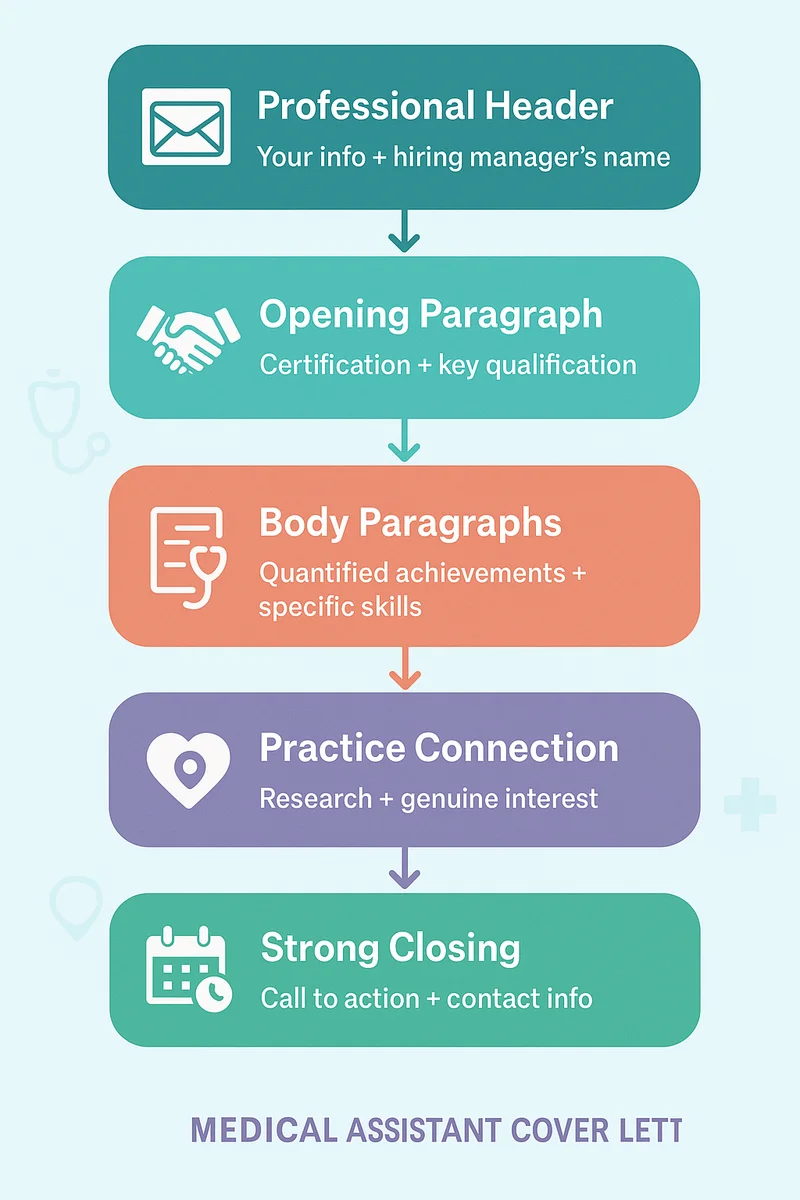
The Five-Part Structure of a Winning Medical Assistant Cover Letter
Part 1: Professional Header and Personalized Greeting (Essential)
Your cover letter should begin with your contact information followed by the date and employer details. Always address the hiring manager by name when possible. Research the clinic's website, call the front desk, or check LinkedIn to find the correct contact person.
Acceptable if name unknown: "Dear Hiring Manager," or "Dear Medical Office Manager,"
Never use: "To Whom It May Concern" or "Dear Sir/Madam"
Part 2: Opening Paragraph - Immediate Value Proposition (3-4 sentences)
Skip the clichéd "I am writing to express my interest" opening. Instead, immediately state your most relevant qualification and why you're an excellent fit. Include your certification status and years of experience right away.
Strong opening: "As a Certified Medical Assistant with four years of experience in high-volume family medicine practices, I bring the combination of clinical expertise and compassionate patient care that Valley Health Clinic is known for. My experience managing electronic health records for 6,000+ patients and consistently achieving 96% patient satisfaction scores aligns perfectly with your commitment to quality care."
Part 3: Body Paragraphs - Demonstrate Your Value (2-3 paragraphs)
This section should accomplish two goals: showcase your relevant achievements and demonstrate knowledge of the employer's practice. Use the STAR method (Situation, Task, Action, Result) to structure your accomplishments, but keep descriptions concise.
- Clinical competencies: Vital signs, phlebotomy, EKG, injections, specimen collection, wound care
- Administrative abilities: Appointment scheduling, insurance verification, medical coding (ICD-10, CPT), billing
- Technology proficiency: EHR systems by name, practice management software, patient portals
- Compliance knowledge: HIPAA, OSHA, infection control protocols
- Specialty-specific skills: If applying to cardiology, mention stress tests and Holter monitors; for dermatology, mention biopsies and cryotherapy
- Number of patients assisted per day or week
- Patient satisfaction scores or improvement percentages
- Efficiency gains (reduced wait times, streamlined processes)
- Accuracy rates for data entry or billing
- Team size supported or managed
Part 4: Connection to the Specific Practice (1 paragraph)
Demonstrate you've researched the employer. Mention something specific about their practice—their patient population, specialty focus, community reputation, recent expansions, or values statement. Then connect this to your own background or professional philosophy.
Specific statement: "Your clinic's focus on serving the underserved Hispanic community in East Los Angeles resonates deeply with my background as a bilingual MA who has spent three years working in community health centers. I understand the cultural sensitivity and language skills required to build trust with patients who may have limited healthcare access."
Part 5: Strong Closing with Call to Action (2-3 sentences)
Close by reiterating your interest, expressing confidence in your fit, and explicitly requesting an interview. Provide your contact information and thank the reader for their consideration.
Strong closing: "I would welcome the opportunity to discuss how my clinical skills and patient-centered approach can contribute to Riverside Medical Center's continued success. I'm available for an interview at your convenience and can be reached at (555) 123-4567 or [email protected]. Thank you for considering my application."
Medical Assistant Cover Letter Examples by Experience Level
Example 1: Entry-Level Medical Assistant (Recent Graduate)
Sarah Chen
(555) 123-4567
[email protected]
linkedin.com/in/sarahchen

January 15, 2025

Ms. Jennifer Martinez
Office Manager
Oakwood Family Practice
2847 Oak Street
Portland, OR 97214

Dear Ms. Martinez,

I am applying for the Medical Assistant position at Oakwood Family Practice.
As a newly Certified Medical Assistant (AAMA) who completed a rigorous
720-hour externship at a high-volume family medicine clinic, I bring
hands-on experience with the clinical and administrative skills essential
to supporting your four-physician practice.

During my externship at Community Health Center, I assisted in treating
35-40 patients daily across all age groups, from pediatric well-checks to
geriatric chronic disease management. I became proficient in taking vital
signs, performing EKGs, administering injections, and conducting
point-of-care testing. On the administrative side, I scheduled
appointments, verified insurance eligibility, and maintained patient
records in eClinicalWorks EHR system with 99.5% accuracy. My preceptor
noted in my evaluation that I "quickly developed the ability to anticipate
provider needs and maintain composure during busy periods."

What draws me to Oakwood Family Practice is your reputation for
comprehensive, relationship-based care and your integration of behavioral
health services. This holistic approach aligns with my belief that
effective medical assisting requires addressing both physical health needs
and patient anxiety or concerns. My training emphasized patient education
and empathetic communication—skills I'm eager to apply while supporting
your team.

I would appreciate the opportunity to discuss how my recent training and
strong work ethic can benefit Oakwood Family Practice. I am available for
an interview at your convenience and can be reached at (555) 123-4567 or
[email protected]. Thank you for considering my application.

Sincerely,
Sarah Chen
Example 2: Experienced Certified Medical Assistant
Marcus Thompson, CMA (AAMA)
(555) 987-6543
[email protected]

January 15, 2025

Dr. Rachel Kim
Medical Director
Northside Cardiology Associates
1523 Medical Plaza Drive
Seattle, WA 98101

Dear Dr. Kim,

I am writing to apply for the Cardiology Medical Assistant position at
Northside Cardiology Associates. With five years of experience as a
Certified Medical Assistant, including three years specifically in
cardiology, I bring specialized skills in cardiac diagnostic procedures
and a track record of improving clinical workflow efficiency.

In my current role at Heart & Vascular Clinic, I support four
cardiologists in treating 50-60 patients daily. I am highly proficient in
performing and interpreting EKGs, conducting stress tests, applying and
monitoring Holter monitors, and assisting with echocardiograms. Last year,
I identified a workflow bottleneck in our stress test scheduling and
proposed a revised protocol that reduced patient wait times by 35% while
maintaining our 98% test completion rate. This initiative earned
recognition from our practice administrator and improved patient
satisfaction scores from 89% to 94%.

My expertise extends to cardiac patient education, particularly for
post-procedure care and medication adherence. I've developed strong
relationships with elderly patients and those with multiple
comorbidities—skills essential for supporting patients with heart failure,
arrhythmias, and post-cardiac intervention needs. I'm also experienced
with Epic EHR, cardiac-specific medical coding, and pre-authorization
processes for cardiac procedures.

Northside Cardiology Associates' reputation for clinical excellence and
your recent expansion to include structural heart interventions excite me
professionally. I am confident that my cardiology-specific experience,
technical skills, and commitment to exceptional patient care would make me
a valuable addition to your team. I would welcome the opportunity to
discuss how I can contribute to your practice's continued success.

I can be reached at (555) 987-6543 or [email protected] to schedule a
conversation. Thank you for your consideration.

Sincerely,
Marcus Thompson, CMA (AAMA)
Example 3: Career Changer (Non-Medical Background)
Jennifer Rodriguez
(555) 456-7890
[email protected]

January 15, 2025

Mr. David Park
Practice Manager
Willow Creek Pediatrics
892 Willow Lane
Austin, TX 78701

Dear Mr. Park,

I am excited to apply for the Medical Assistant position at Willow Creek
Pediatrics. While my professional background is in customer service
management, I recently completed my Medical Assistant certification (RMA)
and 240-hour clinical externship because healthcare has always been my
calling. My unique combination of extensive patient-facing experience and
fresh clinical training positions me to contribute immediately to your
pediatric practice.

For eight years as a retail operations manager, I honed skills directly
transferable to medical assisting: managing high-stress situations calmly,
communicating clearly with diverse individuals, multitasking efficiently,
and maintaining meticulous attention to detail. I consistently managed
teams serving 300+ customers daily while maintaining 95% satisfaction
ratings. These same skills proved invaluable during my externship at
Sunshine Pediatric Clinic, where I quickly adapted to the fast-paced
environment of treating 40+ children daily.

My clinical training included all essential MA competencies: vital signs
assessment, immunization administration, vision and hearing screenings,
specimen collection, and electronic health records management using
Athenahealth. My externship supervisor specifically praised my "natural
ability to comfort anxious children and communicate effectively with
concerned parents"—a skill developed through years of de-escalating
challenging customer situations.

Willow Creek Pediatrics' mission to provide accessible, culturally
sensitive care to Austin's growing Hispanic community resonates
personally. As a native Spanish speaker with deep ties to this community,
I understand the importance of language accessibility in healthcare. I'm
eager to bridge communication gaps and help families navigate the
healthcare system effectively.

I would be grateful for the opportunity to discuss how my customer service
expertise and clinical training can support your practice. Please contact
me at (555) 456-7890 or [email protected] to arrange an interview.
Thank you for considering my application.

Sincerely,
Jennifer Rodriguez
The AI Cover Letter Dilemma: Why Generated Letters Often Fail
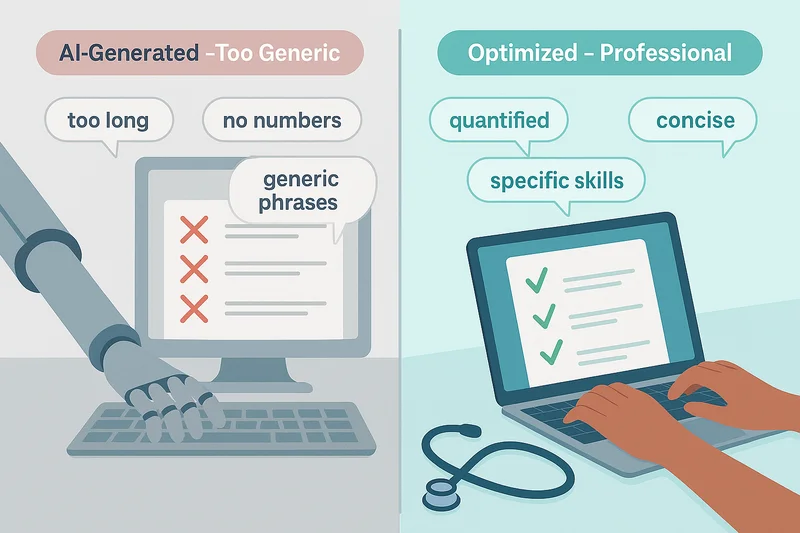
Many medical assistants use AI tools to generate cover letters, but we've identified consistent problems that hurt candidates' chances.
Problem 1: Poor Input Quality = Poor Output
AI can only work with the information you provide. If your resume lacks quantified achievements, the AI-generated cover letter will too.
"I managed high-stakes clinical responsibilities that required meticulous attention to detail. I remember one procurement case where I monitored a donor heart on perfusion for several hours, coordinating closely with the surgical team."
Why this happens: The resume likely listed only: "Monitored donor organs. Coordinated with surgical teams."
Fix your resume first:
Organ Preservation Coordinator (2018-2022)
- Coordinated 127 successful procurements with 98.4% organ viability rate
- Managed perfusion across 15 partner hospitals
- Trained 12 new coordinators
- Reduced average ischemia time by 23%
Now AI has concrete data to generate quantified accomplishments.
Problem 2: Over-Humanizing to Avoid AI Detection
Many AI tools add emotional language to avoid detection, creating verbose, sentimental letters lacking professional keywords.
"When I learned of the opening, it felt like coming full circle. My healthcare journey began decades ago in cardiovascular units, and I've always been drawn to the precision and purpose of cardiothoracic care. Your practice's reputation resonates deeply with the collaborative, patient-centered environment where I believe I can contribute meaningfully."
- 61 words for what should be 2-3 sentences
- No certification status, years of experience, or skills mentioned
- Too emotional: "felt like coming full circle," "resonates deeply"
- Missing keywords: No EHR, HIPAA, or clinical procedures
"I am applying for the Certified Clinical Medical Assistant position at Grandview Cardiothoracic Surgeons. As a CMA with eight years of cardiovascular clinical experience, including three years as an organ preservation specialist, I bring the technical precision and patient-centered approach your practice is known for. My expertise includes cardiac monitoring, EKG interpretation, surgical assistance, and Epic EHR management."
Problem 3: Over-Storytelling vs. Recruiter Scanning
Healthcare recruiters use F-shaped reading patterns per Nielsen Norman Group. They scan first lines of paragraphs for keywords and achievements. Long narratives get skipped.
"What excites me is the opportunity to merge my clinical training with interpersonal skills I've honed in real estate and public service. At Oak Mountain State Park, I learned to prioritize safety and hospitality—often de-escalating tense situations while ensuring guests felt heard and cared for. I see clear parallels in clinical settings."
Improved:
"My background includes five years in high-stress customer service requiring conflict de-escalation and multitasking—skills I successfully applied during my 240-hour clinical externship. In addition to clinical competencies (vital signs, phlebotomy, EKG), I bring proven ability to remain calm under pressure and communicate clearly with anxious patients."
How to Optimize AI-Generated Cover Letters: A Step-by-Step Process
If you choose to use AI tools for your cover letter, follow these steps to ensure quality output:
Step 1: Prepare Quality Input
Before using any AI tool, audit your resume:- Does every job include at least 2-3 quantified achievements?
- Are all technical skills specifically named (Epic vs. "EHR systems")?
- Have you listed certifications with full credentials (CMA-AAMA, not just "certified")?
- Do you mention patient volumes, satisfaction scores, or efficiency improvements?
Step 2: Provide Detailed Context to AI
If manually prompting AI, include:- The complete job description
- Your full resume
- Specific instructions: "Write a 250-word cover letter for a medical assistant position. Include at least three quantified achievements. Mention these required skills from the job description: Epic EHR, phlebotomy, patient scheduling. Use professional but warm tone. Avoid clichés like 'passionate about healthcare.'"
Step 3: Review and Edit Ruthlessly
After AI generates your cover letter:
Length check: Is it 250-300 words? Anything longer needs cutting.Keyword audit: Compare to the job description. Did AI include the top 5-7 required skills?
Quantification check: Count your numbers. Minimum three quantified achievements (percentages, patient volumes, time periods, team sizes).
Authenticity test: Read it aloud. Does it sound like something you would actually say? If it sounds like a robot pretending to be emotional, revise.
Cliché elimination: Delete or rewrite:
- "I am writing to express my interest/enthusiasm"
- "I am passionate about patient care"
- "I am a team player"
- "I believe I would be a great fit"
- "I look forward to hearing from you"
Step 4: Add Personal Touches AI Cannot Provide
AI doesn't know:- Why you're specifically interested in THIS clinic (you need to research and add this)
- Personal connections to the community or patient population
- Specific providers you've researched or admire
- Recent news about the practice (expansion, awards, new programs)
Manually add one sentence that demonstrates genuine research and interest.
Specialty-Specific Considerations
Different medical specialties require different emphases in your cover letter:
Cardiology: Emphasize EKG interpretation, stress testing, Holter monitors, echocardiogram assistance, cardiac patient education. Quantify EKGs performed weekly and stress tests conducted.Dermatology: Highlight biopsy assistance, cryotherapy, laser procedures, wound care, medical photography. Emphasize sterile technique and patient education about skincare.
Pediatrics: Focus on growth monitoring, immunizations, vision/hearing screenings, parent communication. Emphasize patience with children and cultural sensitivity.
OB/GYN: Mention prenatal education, pap smear assistance, family planning counseling, STI screening. Emphasize sensitivity to patient privacy and comfort.
Orthopedics: Highlight cast application, splinting, X-ray positioning, wound care, DME fitting. Emphasize physical stamina and understanding of musculoskeletal conditions.
Common Cover Letter Mistakes to Avoid
1. Generic letters: Customize for each employer. Mention the specific practice name and something unique about them.2. Omitting certification: State your credential clearly (CMA, RMA, CCMA, NCMA) in the opening paragraph.
3. Duties vs. achievements: Instead of "Responsible for taking vital signs," write "Accurately assessed vital signs for 40+ patients daily with zero documentation errors."
4. Ignoring job description: If they emphasize EHR experience, mention your specific system proficiency.
5. Excessive length: Keep it to 250-300 words. Respect hiring managers' time.
6. Typos: In healthcare, attention to detail is critical. Proofread multiple times.
7. Weak closing: Never end passively. Instead: "I would welcome the opportunity to discuss how my qualifications align with your needs."
Frequently Asked Questions
How long should a medical assistant cover letter be?Aim for 250-300 words. Busy healthcare managers prefer concise letters highlighting relevant qualifications.
Should I mention salary requirements?
Only if specifically requested. Otherwise, save salary discussions for interviews.
How do I write a cover letter with no experience?
Focus on clinical training and externship hours. Quantify hands-on experience: patients assisted, procedures performed, skills mastered. Emphasize transferable skills from other work.
Should I address to "Dear Hiring Manager" if I can't find a name?
This is acceptable as a last resort, but always try to find a specific name via the clinic website, phone call, or LinkedIn.
Can I use the same cover letter for multiple jobs?
No. Customize each letter significantly: practice name, specific skills (match job description), why you're interested in that employer, and specialty-specific details.
Should I explain why I left my previous position?
Generally no, unless it strengthens your candidacy (relocated, pursuing training, seeking growth). Focus on what you bring to the new role.
How soon should I follow up after submitting?
Wait 5-7 business days, then send a brief email or call reaffirming interest and asking about interview timelines.
Final Checklist Before Submitting
- Professional header with contact information
- Hiring manager addressed by name (or appropriate alternative)
- Opening states position, certification, and key qualification
- At least three quantified achievements
- 5-7 skills from job description mentioned (EHR by name, procedures, certifications)
- One paragraph showing knowledge of this specific employer
- Specialty-specific skills for the practice type
- Strong closing with call to action
- Length between 250-300 words
- Zero typos or formatting issues
- Customized for this position—not generic
- Saved as PDF: FirstName_LastName_CoverLetter.pdf
Conclusion
A well-crafted cover letter bridges your resume and an interview invitation. While your resume lists qualifications, your cover letter demonstrates how you'll apply them to benefit a specific practice.
Authenticity matters more than perfection. Whether you write from scratch or use AI assistance, ensure the final product sounds like you and accurately represents your experience. Hiring managers spot generic letters that lack genuine connection.
Customize each application. Yes, it requires more effort, but targeted applications yield dramatically better results. Quality always outperforms quantity in medical assistant job searches.
Your cover letter is often your first impression—make it count by being specific, concise, and yourself.