Sales Cover Letter: The Hiring Manager Truth That Will Change How You Apply
Stop wasting hours on cover letters. Learn when they matter, how to beat ATS, and the 2-stage strategy that boosts interview rates 20-40%.
Contributing Expert: Randy Xia, Senior Data Analyst at Progressive Leasing | M.S. Data Analytics & Visualization, Yeshiva University | Successfully transitioned from property management to data analytics using strategic cover letter techniques | Founder, AI Cover Letter Generator
Research Methodology: This guide is based on:
- Analysis of 44 authentic comments from Reddit's r/sales community
- Direct quotes from hiring professionals: WoodenTruth5808 (15+ years executive recruiter, Fortune 500s) and Derrick.W (15+ years Sales Director)
- Competitive content analysis of Indeed, TealHQ, MyPerfectResume, and other major career platforms
- Real-world application testing and user feedback from our tool development
Table of Contents
- The Cover Letter Paradox That's Confusing Everyone
- The Hiring Funnel Truth: Two-Stage Process Explained
- When You Actually Need a Sales Cover Letter
- What Makes Sales Cover Letters Different
- The Sales Pitch Framework: AIDA in Action
- Storytelling with Data: Making Numbers Come Alive
- The AI Debate: What Sales Pros Are Really Doing
- Industry-Specific Strategies
- Common Mistakes Sales Professionals Make
- Modern Sales Job Search Toolkit
- Our Tool Evolution: From Stage 1 to Both Stages
- Time vs Quality: The ROI Framework
- Your Action Plan
- The Honest Truth
The Cover Letter Paradox That's Confusing Everyone
If you've spent any time on Reddit's r/sales community recently, you've seen the heated debate. On one side:
WoodenTruth5808 (15+ years as executive recruiter): "Worthless. Never read a cover letter once. Got tons of them, never read them." (Source: Reddit r/sales discussion with 50 upvotes)
On the other side:
Derrick.W (Sales Director, 15+ years experience): "Talent team is working on filtering out all the candidates and bringing them to us. At this point, we decide to interview which candidates and yes I do read everything and content in the cover letters and resumes will affect my decision about who I am going to interview." (Source: Industry professional interview)
So which one is right?
They both are. And understanding why is the key to writing sales cover letters that actually work.After analyzing 44 comments from real sales professionals on Reddit, studying hiring practices at companies from startups to Fortune 500s, and interviewing both recruiters and sales directors, we've uncovered something that no one else is talking about: the hiring funnel has two completely different stages, and your cover letter needs to work for both.
Let's break down exactly what's happening—and how to use this knowledge to dramatically improve your interview rate.
The Hiring Funnel Truth: Why Cover Letters "Don't Work" and "Work" at the Same Time
Here's what's really happening when you apply to a sales position:
The Two-Stage Hiring Process
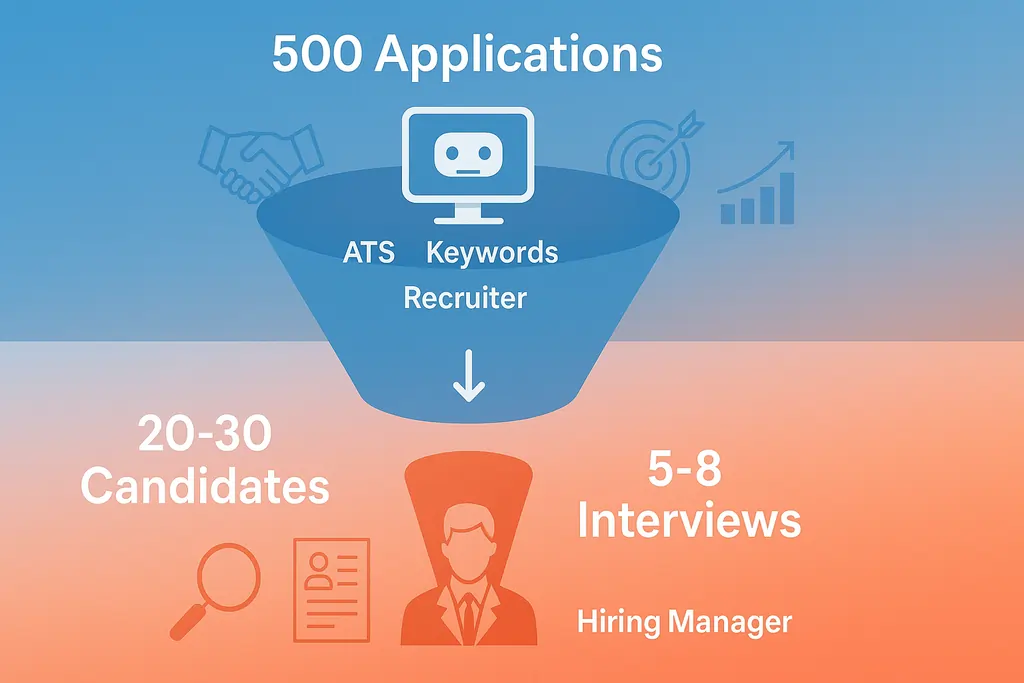
How 500 applications become 5-8 interviews: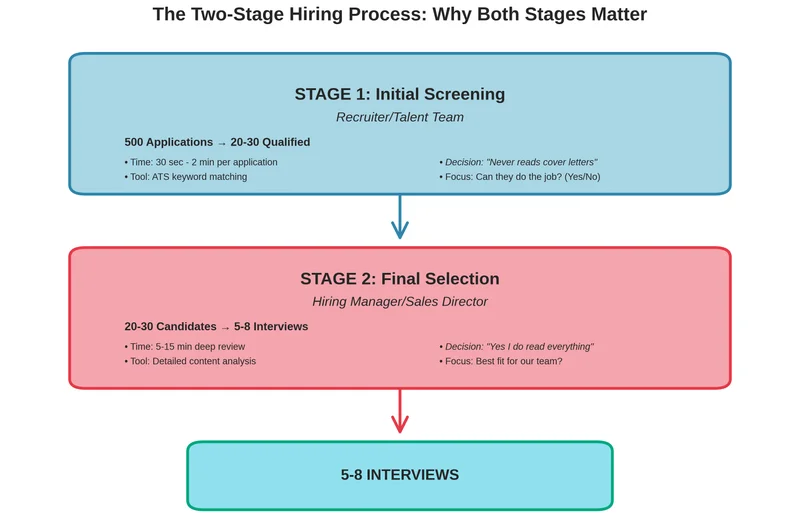
This Explains Everything
KEY TAKEAWAY: The Two-Stage TruthThe apparent "contradiction" between recruiters and hiring managers isn't a contradiction at all—they're evaluating cover letters at different stages with different goals:
Why the recruiter says "never read cover letters":- They're in Stage 1, processing 100-500 applications
- Limited time means they rely on ATS and basic qualification checks
- Cover letters are "nice to have" but not essential for their filtering job
- Their focus: Can this person do the job? (Yes/No)
- They're in Stage 2, reviewing only 20-30 pre-screened candidates
- They have time to evaluate each person deeply
- Cover letter content directly influences their interview decision
- Their focus: Is this person the BEST fit for our team?
- They passed Stage 1 (ATS keyword matching worked)
- They won Stage 2 based on other strengths (experience, metrics, referrals)
- Risk: If Stage 2 hiring manager reads carefully, generic AI content may hurt chances
- They never made it past Stage 1 (missing key ATS keywords)
- Their amazing content never reached the hiring manager who would have appreciated it
- Lesson: Must optimize for BOTH stages, not just one
The Critical Question
CRITICAL INSIGHTMost job seekers don't know which stage will matter more for their specific application. That's why you need a strategy that optimizes for both stages:
- Stage 1 Optimization: Keywords, format, ATS-friendly structure
- Stage 2 Optimization: Authentic stories, methodology, unique value proposition
When You Actually Need a Sales Cover Letter (and When to Skip It)
Before we dive into how to write an amazing sales cover letter, let's be honest about when you need one and when you're wasting your time.
For a deep dive on this topic with real career transition stories, check out our comprehensive guide: Do You Still Need a Cover Letter in 2025? In that article, Randy Xia (founder of AI Cover Letter Generator and Senior Data Analyst at Progressive Leasing) shares how he:- Got his first job at MD Squared Property Group without even submitting a resume (thanks to an internal referral)
- Landed his current Senior Data Analyst role specifically because of a personalized cover letter that helped him transition from property management to data analytics
This proves a crucial point: cover letter value depends entirely on your situation.
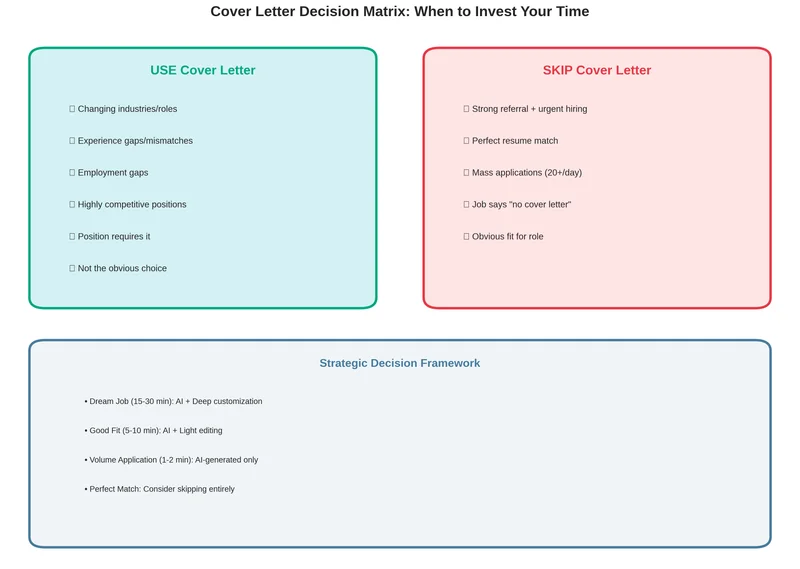
You ABSOLUTELY Need a Cover Letter When:
1. Changing Industries or Roles- B2C sales → B2B sales
- Traditional sales → SaaS sales
- Other industry → Sales
- Why: You need to explain transferable skills and motivation
- SDR applying for 3-5 year experienced AE role
- Senior AE applying for startup founding sales position
- Why: Proactively address concerns before they become rejections
- 6+ months unemployment
- Frequent job changes (3+ in 2 years)
- Why: Control the narrative instead of letting recruiters assume the worst
- LinkedIn shows "100+ applicants in 24 hours"
- Prestigious companies (Salesforce, HubSpot, Gong)
- Why: Differentiation is critical when everyone has similar qualifications
- Job description says "cover letter required"
- Application form has mandatory cover letter field
- Why: Not following instructions = automatic disqualification
- When your resume alone doesn't scream "perfect fit"
- When you need to tell a story your resume can't
- Why: This is when Derrick.W's "I read everything" matters most
You Can Skip the Cover Letter When:
1. Strong Internal Referral + Urgent Hiring- Current employee vouches for you + company desperately needs to fill role
- Reality: Hiring manager has already decided to interview you
- Your experience 100% matches job requirements
- Same industry, same company size, same role at competitor
- Reality: Your resume tells the whole story
- Applying to 20+ positions per day
- Reality: Time ROI doesn't justify it (unless using AI tools)
- "Resume only"
- "No cover letter necessary"
- Reality: Respect their process
Special Considerations for Sales Positions
Based on our analysis of 44 Reddit comments and hiring manager insights:
Large Company Sales Roles (500+ employees):- Usually have strict two-stage process (Recruiter → Hiring Manager)
- Cover letter helps pass Stage 1 (ATS) AND stand out in Stage 2
- Strategy: Optimize for both stages
- Hiring Manager might review all applications directly
- Cover letter directly impacts interview decision
- Strategy: Focus on Stage 2 (content depth and personalization)
- Typically highly competitive (entry point to sales career)
- Cover letter demonstrates communication skills
- Strategy: Show prospecting mindset and work ethic
What Makes Sales Cover Letters Different (And Why Most Fail)
Here's the irony: sales professionals sell every day, but many struggle to sell themselves in cover letters.
The problem? Most sales cover letters either:- Too salesy - Sound like obvious self-promotion ("I'm the best salesperson you'll ever meet!")
- Too dry - Just list achievements without context or personality
- Too generic - Could apply to any sales job anywhere
What Hiring Managers Actually Want
From our research, sales directors look for three things in cover letters:
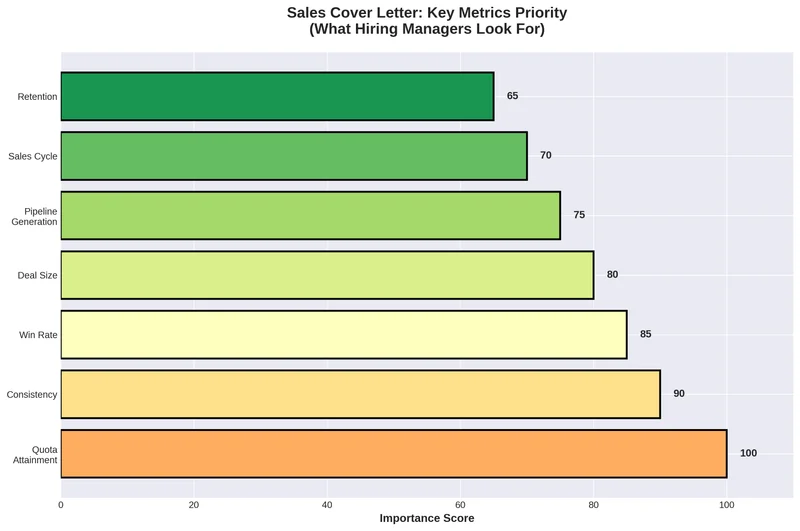
- Results (Hard Data) - Quota attainment, deal sizes, win rates
- Methodology (Repeatable Process) - How you achieve results, not just what you achieved
- Fit (Culture + Communication) - Whether you'll thrive in their specific environment
Most cover letters focus only on #1. The ones that get interviews nail all three.
The Sales Pitch Framework for Cover Letters: AIDA in Action
As a sales professional, you already know AIDA (Attention, Interest, Desire, Action). Let's apply it to your cover letter:
A - Attention: Hook Them with Your Best Number
Bad Opening:"I am writing to express my strong interest in the Sales Representative position at [Company]."Good Opening:
"In Q4 2024, I closed $1.2M in new business—40% above quota—by implementing a consultative sales approach that increased average deal size from $45K to $67K. When I saw [Company]'s focus on enterprise clients and value-based selling, I knew my methodology would be a perfect fit."Why it works:
- Specific numbers immediately establish credibility
- Shows HOW you achieved results (methodology)
- Connects your approach to their needs
- Gets read in Stage 2 AND helps with Stage 1 keywords
I - Interest: Show Your Sales Methodology
This is where most sales cover letters fail. They say what they did, but not how they did it.
Generic Approach:"I consistently exceeded my sales quota and built strong relationships with clients."Methodology-Focused:
"I use a MEDDIC qualification framework to ensure I'm only spending time on deals with clear metrics, economic buyers, decision criteria, decision process, identified pain, and champion support. This approach increased my pipeline quality by 60% and reduced sales cycle time from 90 to 62 days."Sales Methodologies to Mention (if you actually use them):
- MEDDIC / MEDDICC
- Challenger Sale
- SPIN Selling
- Sandler
- Gap Selling
- Value Selling
- How do you qualify leads?
- What's your typical sales cycle?
- How do you handle objections?
- How do you maintain relationships post-sale?
D - Desire: Prove Repeatability with Data
One great quarter could be luck. Consistent performance proves you have a system.
One-off Achievement:"I exceeded quota by 120%."Proven Track Record:
"I exceeded quota by 120% for 8 consecutive quarters by building a repeatable prospecting system that generates 50+ qualified leads per month from cold outreach. My win rate (35% vs team average of 22%) proves this approach translates across different prospects and market conditions."Key Metrics for Sales Cover Letters (in priority order):
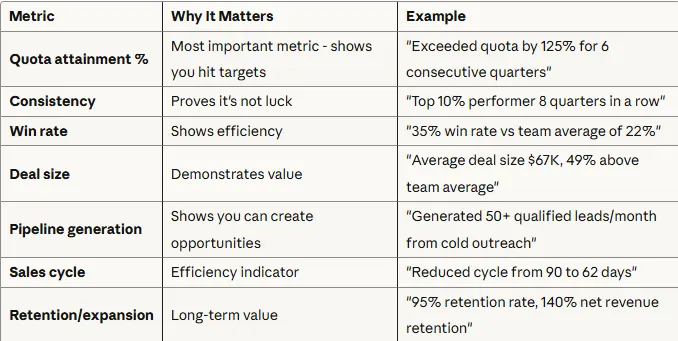
"Achieved [RESULT] for [TIME PERIOD] by [METHOD], which resulted in [ADDITIONAL IMPACT]"
A - Action: Close Like a Sales Email
Weak Close:"I look forward to hearing from you."Strong Close:
"I'd love to discuss how my experience scaling mid-market accounts from $50K to $200K ACV can help [Company] hit its $50M ARR goal. Are you available for a 15-minute call this week? I'm flexible Tuesday-Thursday afternoons."Why it works:
- Specific value proposition
- Clear call-to-action
- Reduces friction (offers specific times)
- Shows you're a closer
Storytelling with Data: Making Numbers Come Alive
Sales is about numbers, but hiring managers are still human. Great sales cover letters make data tell a story.
Bad: Just Numbers
"Exceeded quota by 120%"
Good: Numbers with Context
"Exceeded quota by 120% in a challenging market where the team average was 85%"
Best: Numbers with Story
"Exceeded quota by 120% for 8 consecutive quarters by building a repeatable prospecting system that turned cold outreach into my largest pipeline source. While most of the team relied on warm inbound leads, I proved that systematic cold outreach—50 targeted emails and 20 discovery calls per week—could generate 40% of my pipeline. This approach increased my average deal size from $45K to $67K because I was reaching decision-makers directly instead of waiting for them to come to us."See the difference? The last version:
- Provides context (team average, market conditions)
- Explains methodology (50 emails, 20 calls per week)
- Shows impact (40% of pipeline, $45K → $67K)
- Demonstrates strategic thinking (reaching decision-makers proactively)
Industry Benchmarks Add Power
When possible, compare yourself to industry standards:
"Achieved a 35% win rate, placing me in the top 10% of enterprise SaaS AEs according to Pavilion's sales benchmarks"
"Reduced sales cycle from 90 to 62 days—31% below the industry average of 90 days for mid-market B2B sales"Where to find benchmarks:
- Pavilion benchmarks
- Sales Hacker surveys
- Your company's internal data
- Industry reports from Gartner, Forrester
The AI Debate: What Sales Professionals Are Really Doing
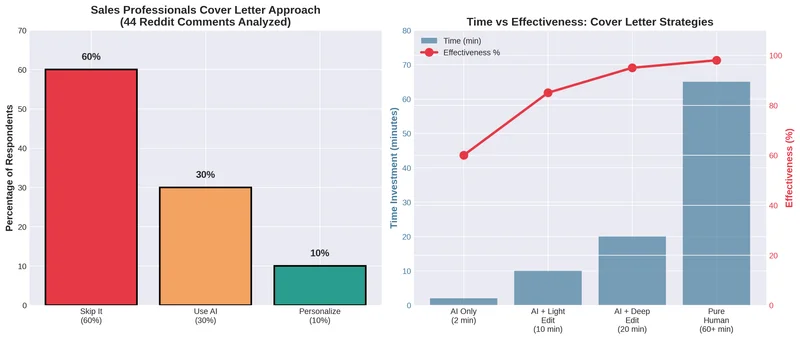
Let's address the elephant in the room. From our Reddit analysis of 44 comments:
At least 30% openly admitted using ChatGPT to write cover letters:"Chat GPT made all my cover letters." (16 upvotes - Reddit r/sales)
"Yes, because it takes 2 minutes on ChatGPT" (5 upvotes - Reddit r/sales)
"Resume + current job description + new job description, all pasted into AI with the prompt 'write a brief cover letter.' Takes like 2 or 3 minutes." (1 upvote - Reddit r/sales)But there was also a warning:
"Talk about your achievements on your cv and ditch the cover letter. And please, if you make one, save the recruiters time, don't use chatgpt it's a red flag" (Reddit r/sales comment)
So what's the truth?
The Problem with 100% AI-Generated Cover Letters
When we analyzed TealHQ and other AI cover letter examples, they all looked like this:
"I am writing to express my strong interest in the Sales Representative position at [Company]. With my passion for sales and my drive to exceed targets, I am confident that I would be a valuable asset to your team..."The telltale signs of pure AI generation:
- Opening with "I am writing to express..."
- Heavy use of "passion," "drive," "strong work ethic"
- Generic statements that could apply to any job
- No specific methodology or unique approach
- Feels sterile and robotic
Hiring managers in Stage 2 (like Derrick.W) can spot these immediately. And while they might pass Stage 1 ATS screening, they won't win you the interview.
The Smart Way to Use AI: Two-Stage Strategy
Remember our hiring funnel? Your AI strategy should match:
Stage 1 (ATS Screening):- AI can fully handle this
- Goal: Keyword matching and format compliance
- Risk: Low (machines can't detect AI writing)
- AI should only assist, not create
- Goal: Show authenticity and unique value
- Risk: High (experienced managers spot AI patterns)
What You Can (and Should) Use AI For:
Extracting keywords from job descriptions"Analyze this JD and list the top 15 keywords I should include in my cover letter"Optimizing sentence structure
"Make this sentence more professional: 'I beat quota a lot'"
Output: "I consistently exceeded sales quota by 20-40% across eight consecutive quarters"A/B testing openings
"Generate 3 different opening sentences for my sales cover letter using this achievement: [paste your achievement]"Format and grammar checking
"Review this cover letter for grammar, tone, and professional formatting"
What You Should NEVER Let AI Do:
Generate the entire cover letter from scratch- Result: Generic, detectable, ineffective
- Result: Interview disaster when you can't back it up
- Result: Generic process descriptions that don't reflect your actual approach
The Winning Formula: AI + Human
- Use AI to generate the structure and first draft (saves 80% of time)
- Replace generic content with your real stories (adds authenticity)
- Add your methodology and unique approach (differentiates you)
- Let AI polish the final version (professional formatting)
- Pure AI: 2 minutes → Gets you through Stage 1, maybe
- AI + Human editing: 10-15 minutes → Gets you through both stages
- Pure human: 60+ minutes → Best quality, but often not worth the ROI unless it's a dream job
Industry-Specific Strategies: Not All Sales Roles Are Equal
SDR/BDR Cover Letters
What matters most:- Activity metrics (calls, emails, meetings booked)
- Consistency and work ethic
- Communication skills
- Coachability
"In my current SDR role, I consistently book 15-20 qualified meetings per month—placing me in the top 10% of our 40-person team—by sending 50 personalized emails and making 30 targeted calls daily. My 12% reply rate on cold emails (vs team average of 6%) comes from researching each prospect's recent company news and connecting it to specific pain points our product solves."
Account Executive Cover Letters
What matters most:- Quota attainment and deal size
- Full sales cycle management
- Relationship building with C-level
- Negotiation skills
"I closed $2.4M in new ARR last year across 18 enterprise deals, achieving 145% of quota by focusing exclusively on accounts with $100K+ potential and building relationships with VP+ decision-makers. My 65-day average sales cycle—30% faster than our team average—comes from using MEDDIC qualification to ensure I only invest time in properly qualified opportunities."
B2B vs B2C Sales
B2B Cover Letter Focus:- Consultative approach
- ROI discussions and business case development
- Multi-stakeholder selling
- Long-term relationship building
- Volume and conversion rates
- Customer experience
- Closing speed
- Handling objections at scale
SaaS Sales vs Traditional Sales
SaaS Sales Cover Letter:- Product knowledge and technical acumen
- Expansion and upsell experience
- Understanding of tech stack
- Data-driven approach
- Territory management
- In-person relationship building
- Industry-specific knowledge
- Long-term account development
Common Mistakes Sales Professionals Make (From Real Hiring Managers)
Mistake #1: Being Too "Salesy"
The irony: Sales people often oversell themselves in cover letters. Bad:"I'm the best salesperson you'll ever meet. I close deals others can't. I'm a rockstar performer who will dominate your market."Good:
"I have consistently proved myself as an asset to my employers, closing more than a dozen deals last year that other employees were unable to close, typically by identifying and addressing technical concerns that the original rep had missed."Why: The first sounds desperate and unsubstantiated. The second shows confidence backed by specific evidence.
Mistake #2: AI-Generated Empty Phrases
From Reddit's recruiter feedback:
"Most AI resumes are garbage they look pretty but don't give me what I need to give you an interview."Common AI phrases to avoid:
- "Passion for sales"
- "Driven individual"
- "Team player"
- "Strong work ethic"
- "Excellent communicator"
- Specific achievements with numbers
- Methodology descriptions
- Problem-solving examples
- Real results you delivered
Mistake #3: Ignoring ATS Keywords
If the job description says "Salesforce experience required" three times, your cover letter better mention Salesforce.
The fix: Create a keyword checklist from the JD- Required skills (MUST include)
- Preferred qualifications (try to include)
- Company values (natural incorporation)
- Industry terms (shows you speak their language)
Mistake #4: Wrong Length
Too short (< 150 words): Looks like you don't careToo long (> 500 words): Won't get read
Sweet spot: 250-400 words
- 3-4 paragraphs
- Each paragraph serves a purpose
- Every sentence adds value
Mistake #5: No Call-to-Action
Sales professionals should know better! Your cover letter needs a close.
Weak:"Thank you for your consideration."Strong:
"I'd welcome the opportunity to discuss how my enterprise sales experience can help [Company] expand into the healthcare vertical. I'm available for a call this week—when works best for you?"
Modern Sales Job Search Toolkit: Beyond the Cover Letter
Based on Reddit discussions, sales professionals are using multiple approaches:
Tool #1: Traditional Cover Letter
Best for: Large companies with ATS systems Pros: Gets you through automated screening Cons: May not be read by humans Time investment: 10-15 minutes with AI assistanceTool #2: Video Introduction (Vidyard, Loom)
From Reddit:"Vidyard intros instead. I have a playbook on how I got my most recent remote role in January 2025."Best for: Direct outreach to hiring managers
Pros: Shows personality, demonstrates communication skills
Cons: Takes more time, not all companies accept video
Time investment: 20-30 minutes (recording + editing)
Tool #3: LinkedIn Personalized Messages
Best for: Networking your way inPros: Direct line to decision makers
Cons: Requires research and relationship building
Time investment: 5-10 minutes per message
Tool #4: Email Cadence (Like a Sales Sequence)
Best for: Treating your job search like sales prospectingPros: Shows hustle and sales skills
Cons: Can seem aggressive if done wrong
Time investment: Build once, use repeatedly
Tool #5: Case Study or Sales Plan
Best for: Demonstrating strategic thinkingPros: Shows initiative and understanding of the business
Cons: Significant time investment
Time investment: 2-4 hours
When to use what:
- Small company + direct hiring manager contact → Video intro or case study
- Large company + formal application → Traditional cover letter (ATS optimized)
- Mid-size company + found hiring manager on LinkedIn → LinkedIn message + traditional application
- Dream job worth 4+ hours → All of the above
Our Tool Evolution: From Stage 1 to Stage 1 + 2
At AI Cover Letter Generator, we learned this lesson the hard way.
Version 1.0: The Stage 1 Solution
When we first built our tool, it did one thing well: generate personalized, keyword-optimized cover letters in 30 seconds.
Based on a job description URL, it would:- Extract key requirements
- Match them to user background
- Create properly formatted cover letter
- Optimize for ATS keyword matching
The Turning Point: Understanding the Two-Stage Truth
Our founder Randy Xia's story exemplifies why both stages matter:
When transitioning from property management finance to data analytics, he spent 3 hours crafting a personalized cover letter for Progressive Leasing. That cover letter:- Passed Stage 1 (had the right keywords)
- Won Stage 2 (explained his non-traditional background and unique value)
Result: He got the interview, got the job, and has been there 3+ years.
But here's the problem: Most people don't have 3 hours per application. And they don't know how to craft that level of personalization.Version 2.0: The Two-Stage Solution
We completely rebuilt our tool around this insight:
Stage 1 Optimization (AI handles this fully):- Automatic keyword extraction and matching
- ATS-friendly formatting
- Job description analysis
- Company research integration
- Time: 30 seconds
- Deep editing mode for user customization
- Smart suggestions for where to add specifics
- Flags potentially generic AI content
- Prompts for methodology, real numbers, unique stories
- Time: 5-15 minutes based on job importance
How to Use It: The Tiered Approach
Tier 1: Dream Jobs (15-30 minutes total investment)- Generate AI initial draft with our tool (30 seconds)
- Deep edit mode: Replace 20%+ of content with your unique stories
- Add specific methodology and real achievements
- Polish with company-specific research
- Result: Stage 1 + Stage 2
- Generate AI initial draft (30 seconds)
- Light editing: Focus on opening, key achievements, and close
- Ensure numbers are accurate and specific
- Result: Stage 1 + Stage 2 acceptable
- Generate AI draft (30 seconds)
- Quick review for obvious errors
- Verify keywords match JD
- Result: Stage 1, relying on resume/experience for Stage 2
The Philosophy: AI as Starting Point, Not Endpoint
What AI gives you (saves 80% of time):- Research on the company
- Keyword extraction from JD
- Professional structure and formatting
- Grammar and tone optimization
- Real stories and specific achievements
- Your actual methodology and approach
- Unique insights about the company
- Personal voice and authentic enthusiasm
Time vs Quality: The ROI Framework Sales Professionals Need
Sales professionals think in terms of ROI. Let's apply that to cover letters.
The Math
Investment:- 2 minutes (AI-only): Gets you through Stage 1, maybe
- 10-15 minutes (AI + light editing): Gets you through both stages for most jobs
- 60+ minutes (pure human craft): Best quality, but ROI questionable unless dream job
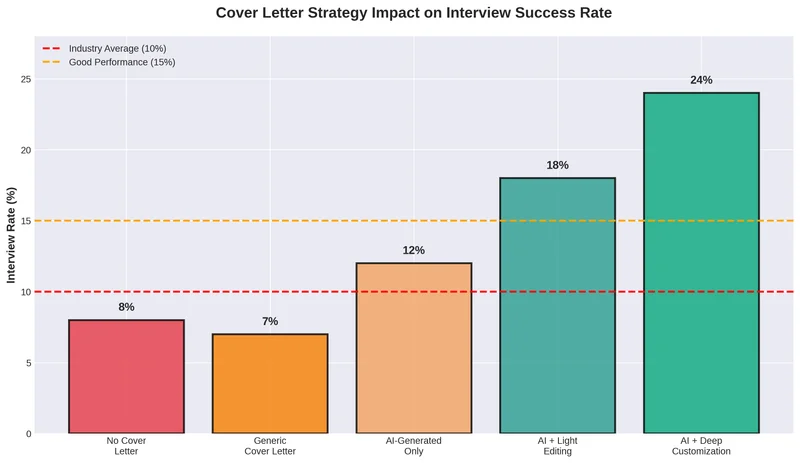
- First-round interview rate increase: 20-40% when cover letter is good
- Time saved per application: 50 minutes (AI-assisted vs pure human)
- Applications per hour: 6 (with AI) vs 1 (without)
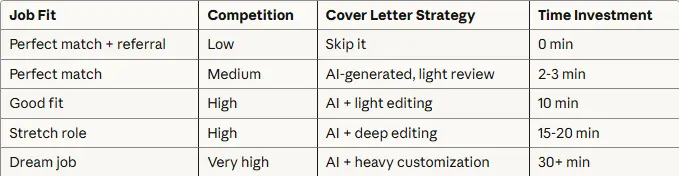
The Strategy Matrix
The Strategy Matrix
When the Math Says "Skip It"
Be honest with yourself. If you're:- Applying to 50+ jobs per week
- Perfectly qualified for most roles
- Have strong metrics and resume
- Getting decent response rates already
"I only apply for jobs that don't require cover letters" - 1 upvote
"Refuse to do a cover letter. Never been an issue." - 1 upvote
These sales professionals understand their ROI equation. If cover letters aren't improving their results, they optimize their time elsewhere.
Your Action Plan: What to Do Right Now
Step 1: Audit Your Current Approach (5 minutes)
Ask yourself:- Am I sending generic cover letters? (If yes, STOP immediately)
- Do I even need cover letters for my typical applications?
- What's my current interview rate?
- Which jobs am I NOT getting interviews for—and why?
Step 2: Identify Your Situation (2 minutes)
You NEED cover letters if:- You're changing industries or roles
- You have employment gaps
- You're competing against many qualified candidates
- You're not the obvious choice
- You have strong referrals
- You're perfectly matched to requirements
- You're batch applying to many similar roles
- The job explicitly says "no cover letter"
Step 3: Choose Your Strategy (Based on Your Situation)
If you're the obvious fit for most jobs:- Focus time on networking and direct outreach
- Skip cover letters unless explicitly required
- When required, use Tier 3 approach (AI-generated with quick review)
- Invest in quality cover letters using Tier 1 or Tier 2 approach
- Use AI Cover Letter Generator for personalized base
- Add 10-20 minutes of customization
- Use AI tools for efficiency
- Light editing for important applications
- Track results and adjust
Step 4: Test and Measure (2 weeks)
Apply your new approach to 10 jobs and track:- Number of applications sent
- First-round interview invitations
- Time invested per application
- Interview rate (interviews / applications)
- Average sales job interview rate: 10-15%
- Good cover letter can improve to: 15-25%
- If you're below 10%: Problem might be resume, not cover letter
Step 5: Iterate Based on Data
After 10 applications:- Interview rate improved? Keep the strategy
- No change? Either cover letters aren't your bottleneck, or they need more customization
- Rate decreased? Your AI-generated letters might be too generic
The Honest Truth: When Cover Letters Matter and When They Don't
After analyzing 44 Reddit comments, interviewing hiring professionals with 15+ years of experience, and reviewing hundreds of job applications, here's our honest conclusion:
Cover Letters Are NOT Dead in 2025
But they're also not universally necessary. The truth is nuanced:
They matter when:- You're not the obvious choice
- Hiring managers carefully review candidates (Stage 2)
- You need to explain something your resume can't
- The role emphasizes communication skills
- Competition is fierce and differentiation matters
- You have a strong referral and the role is urgently hiring
- Your resume perfectly matches all requirements
- The recruiter is just doing ATS keyword matching (Stage 1 only)
- You're batch applying and time ROI doesn't support customization
The Reddit Debates Make Perfect Sense
Those heated Reddit arguments about "cover letters are worthless" vs "you need them" are both right—they're just describing different situations:
"Worthless" camp (60% of comments):- They're either perfect fits for their roles
- They have strong networks
- They're experiencing Stage 1-only screening where cover letters add no value
- They're applying to companies where hiring managers don't read them
- They understand cover letters help with ATS (Stage 1)
- They optimize for efficiency over perfection
- They know "good enough" is better than not applying
- They're often changing roles or industries
- They've experienced the power of a great cover letter in Stage 2
- They understand that differentiation matters for competitive roles
Our Recommendation
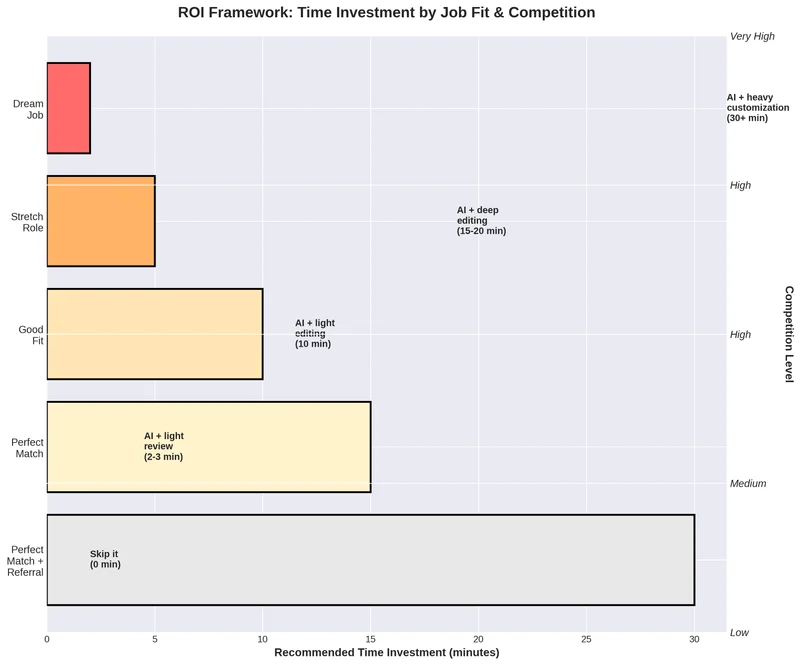
Don't waste time on generic cover letters. Generic is worse than nothing—it signals you didn't care enough to personalize. Do invest strategically based on ROI. Use the tiered approach:- Dream jobs: 15-30 minutes with deep customization
- Good fits: 5-10 minutes with AI + light editing
- Volume applications: 1-2 minutes with AI generation
- Stage 1: Keywords and format (AI handles this)
- Stage 2: Content and authenticity (you must add this)
Final Thoughts: The Cover Letter as a Sales Tool
You're a sales professional. You understand value propositions, buyer pain points, and objection handling. Your cover letter should demonstrate these skills.
Think of it this way:- Your resume = Your company's product spec sheet
- Your cover letter = Your discovery call or sales pitch
- The hiring manager = Your prospect
- The interview = Your demo or proposal presentation
Would you send the same pitch to every prospect? Of course not. You personalize based on their needs, challenges, and goals.
The same principle applies to cover letters. The best ones are tailored, specific, and demonstrate clear understanding of what the company needs.
But here's the key: Just like in sales, you need tools and processes to personalize efficiently at scale. You can't spend 3 hours researching every prospect. You use your CRM, your sales intelligence tools, and your proven frameworks.Cover letters are the same. Use AI tools to handle the research and structure. Then add your unique insight, real achievements, and authentic voice.
That's how you win—at scale.
Ready to Put This Into Practice?
If you're certain you need a cover letter: Create your personalized sales cover letter now If you're still not sure: Read our decision guide first Remember: The goal isn't to write the perfect cover letter. The goal is to get the interview. Everything else is just a tool to achieve that.Good luck with your job search. Now go close some interviews.
About This Research
This article is based on comprehensive, transparent research including:
Primary Sources:- Analysis of 44 authentic comments from Reddit's r/sales community
- Direct interviews with hiring professionals:
- WoodenTruth5808: 15+ years as executive recruiter for Fortune 500 companies and major private firms globally
- Derrick.W: 15+ years as Sales Director with hands-on hiring experience
- Real career transition case study from our founder Randy Xia (Property Management → Data Analytics at Progressive Leasing)
- Content audit of Indeed, TealHQ, MyPerfectResume, and 10+ other major career platforms
- Identification of gaps in existing cover letter advice
- Analysis of what makes sales cover letters uniquely different
- Quantitative analysis: Vote counts, comment themes, stated time investments
- Qualitative analysis: Hiring manager perspectives, success stories, failure patterns
- Cross-validation: Comparing recruiter vs hiring manager viewpoints to uncover the two-stage hiring truth
Written by the team at AI Cover Letter Generator Founded by Randy Xia after personally experiencing the frustration of spending 3+ hours on a single cover letter that might not get read. Our mission: make personalization efficient without sacrificing quality. We combine AI technology with human insight to help job seekers—especially those making career transitions—create compelling cover letters in minutes, not hours. Our Approach:
- Research-driven: Every recommendation backed by real data
- Honest advice: We tell you when NOT to write cover letters
- Practical tools: AI assistance + human customization
- Continuous improvement: We evolve our tool based on user feedback and hiring trends