ATS Optimization: Real Requirement or Fear-Based Marketing?
ATS optimization advice is everywhere — but a Reddit recruiter says the real filter is time submitted, not keywords. Here's what actually moves the needle in 2026.
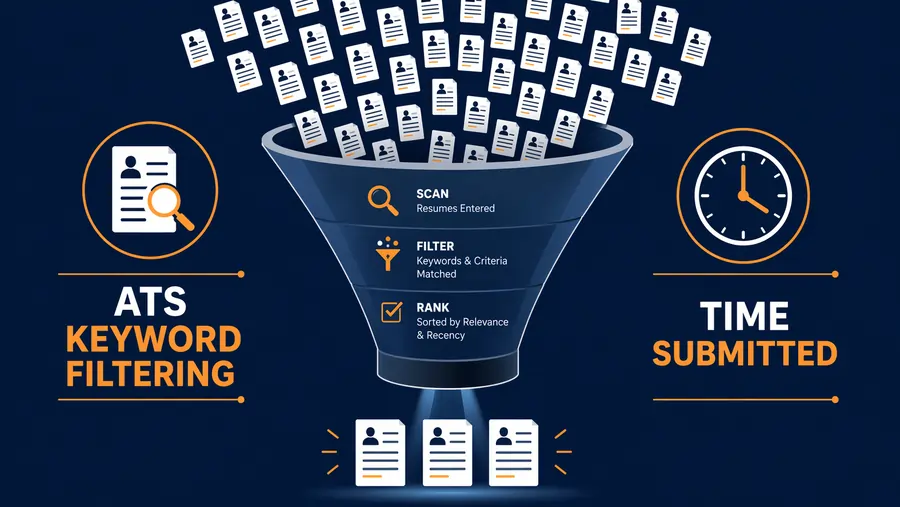
- ATS systems at most companies sort resumes by time submitted, not keyword score — applying early often matters more than optimizing
- Keyword alignment does matter, but only when an employer is using automated pre-filtering, which is far more common at large organizations than small ones
- The real problem behind most failed applications is bullet quality and unclear relevance — not missing keywords
- A 15-minute curation approach (pulling from a master resume) outperforms rewriting your resume from scratch for each application
- Run an ATS check as a quick sanity check before submitting to large employers — not as a guarantee of success
The post she was responding to had 34 upvotes — a sign that plenty of job seekers found it useful. Her pushback got upvotes too. Neither side was obviously wrong.
That's the problem with ATS advice in 2026. For every recruiter who swears keyword optimization is the difference between getting noticed and getting filtered, there's another industry voice saying the whole framework is a sales pitch designed to make you buy software you don't need.
This article doesn't resolve the debate by picking a side. Instead, it lays out both arguments as clearly as possible — the real reasoning behind each — so you can make an informed call about how much time and energy to spend on ATS optimization in your own job search.
What Is ATS, and Why Does Everyone Keep Talking About It?
ATS stands for Applicant Tracking System. It's the software that most medium-to-large employers use to receive, store, and sort job applications. When you apply through a company's careers page and upload your resume, it goes into an ATS before any human sees it.
What the system does with your resume varies. Some ATS platforms rank candidates automatically based on keyword matches with the job description. Others simply organize applications by date received, and a recruiter manually reviews from the top down. Many large enterprises use a combination.
The "ATS optimization" industry has grown up around the fear that your resume is being rejected by software before a human ever reads it — and that the solution is to reverse-engineer the system with the right keywords.
That fear is at least partially founded. But how partially? That's where people disagree.
The Case for ATS Optimization
Keywords Do Matter — Sometimes Literally
The most straightforward argument for optimization is this: if a recruiter is using an ATS to filter by specific terms, your resume either contains those terms or it doesn't.
A software engineer who writes "Built APIs" on their resume might get filtered out for a role that requires "RESTful API development" — not because they're unqualified, but because the system didn't match their phrasing to the job description's phrasing. Same skill. Different words. No interview.
This isn't hypothetical. It's a documented pattern that resume professionals see regularly, and it's the core argument for why tailoring your resume's language to match the job description is worth doing.
In the r/ResumeCoverLetterTips thread that inspired this article, u/Realistic-Edge-6065 made exactly this point: using AI to pull out key features from the job description and match them to your resume does work. That's not keyword stuffing — it's alignment. You're not adding skills you don't have; you're expressing the skills you do have in the language the employer is using.
The 15-Minute Tailoring Approach
One practical framework that gets real traction among job seekers: maintain a "master resume" that contains every bullet point, achievement, and skill you've ever had. When you apply to a specific role, spend 15 minutes pulling the most relevant sections into a tailored version.
This isn't rewriting your resume from scratch. It's curation. The goal is to ensure that the first third of your document — the part a recruiter sees in the first 5–10 seconds — maps clearly to what this specific employer has said they're looking for.
For job seekers applying to roles where they're genuinely qualified, this approach reportedly increases interview rates. The keyword signals help with automated screening; the relevance-first structure helps when a human picks it up.
Large Companies Use Heavier Screening
ATS matters significantly more when you're applying to organizations that receive thousands of applications per month — Fortune 500 companies, major healthcare systems, large government contractors.
At that scale, a recruiter reviewing every resume manually is simply not possible. The ATS does meaningful pre-filtering. Getting your document through that filter isn't gaming the system — it's table stakes.
The Case Against ATS Optimization (or At Least Against Obsessing Over It)
ATS Sorts by Time Submitted, Not Keyword Score
Here's a detail that undercuts a lot of ATS advice: for most systems, the primary sort is chronological.
u/HeadlessHeadhunter, a recruiter who contributed to the Reddit thread, explained it plainly. ATS systems typically display applicants in the order they applied. When a recruiter opens the queue, they work from the top down. They stop reviewing when they have enough candidates to fill their interview schedule — which might happen at applicant #130 out of 600.
If you are resume #582, even a perfectly optimized document may never get reviewed. Not because the ATS rejected it, but because the role was already filled by the time a human got to your place in the queue.
The implication is uncomfortable: spending an extra hour tailoring your resume might actually hurt you by delaying your submission. Every minute you spend optimizing is a minute someone less optimized submits ahead of you.
This doesn't mean optimization is worthless. But it does mean the "your resume was rejected by ATS" story is often incomplete. Sometimes the more accurate story is: "You applied too late, and there weren't enough interview slots left."
The Fear Is Being Monetized
The resume industry has a financial interest in convincing you that ATS systems are sophisticated, aggressive, and impossible to game without professional help.
u/DorianGraysPassport — a resume writer who spends all day on this — was direct about it in the same discussion. In her view, the real problem isn't that job seekers are failing ATS screenings. It's that their bullets sound like statements instead of achievements, their resume tries to serve three different career directions at once, and they're applying to roles they're not actually qualified for. ATS keyword matching is a legitimate factor — but it's downstream of the more fundamental question: does this resume coherently tell the story of a qualified candidate? If the answer is no, better keywords won't fix it.
AI Keyword Stuffing Makes Things Worse
There's a trap that snares a lot of people when they use AI tools to optimize for ATS: the AI adds keywords in ways that sound awkward and unnatural to any human reader.
A recruiter who picks up your resume after it passes ATS screening will notice when the language feels forced — when every third bullet seems to exist to hit a term from the job description rather than to describe something you actually did. That friction doesn't help you.
Experienced recruiters can identify this pattern in seconds. The resume that passed the automated screen fails the human one.
The Nuanced Truth: Small vs. Large Companies
ATS optimization matters differently depending on where you're applying. Here's a practical breakdown:
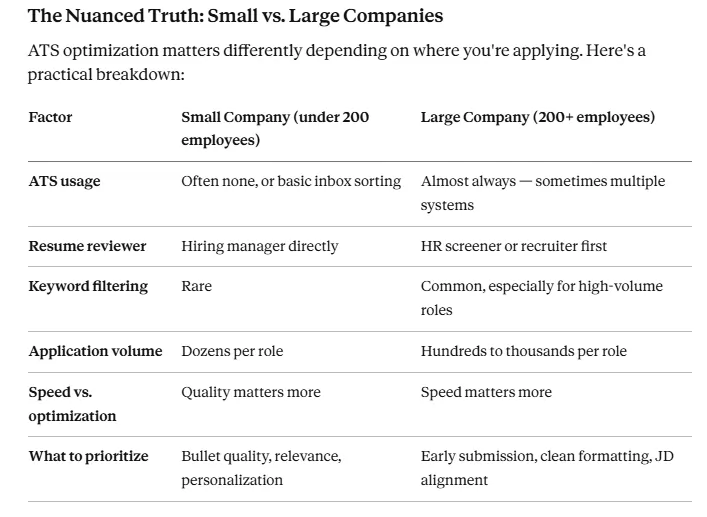
The short version: the larger the employer, the more ATS optimization matters — but even then, it's a floor, not a ceiling. Getting through automated screening doesn't get you the job; it just gets your resume in front of a human.
What Actually Moves the Needle
After weighing both sides, here's where the evidence points.
Speed matters more than perfection. If you're going to tailor your resume, do it quickly and submit early. A good-enough resume submitted in hour one will often outperform a perfectly optimized resume submitted on day three. Use the 15-minute curation approach rather than a complete rewrite.
There is no universal ATS keyword list. ATS systems are configured differently by each employer. The terms that matter are the ones in the specific job description you're applying to — not some generic list of "ATS-friendly keywords" a blog post generated. Match the language in the JD; ignore everything else.
Bullet quality is not optional. u/HeadlessHeadhunter summarized his own review criteria: black and white, single column, Arial 10.5, no more than 3–5 things bolded in the entire resume. The purpose of the document, in his words, is to show minimum qualification — not to stand out or demonstrate how exceptional you are. If your bullets don't demonstrate that you've met the baseline bar for this role, no keyword density will save you.
The top third of your resume carries disproportionate weight. Whether an ATS or a human is doing the first pass, your headline, summary, and first job entry get the most attention. If those sections don't immediately signal relevance for the role you're applying to, you've likely already lost the reader.
What This Means Practically
If you're in an active job search, here's how to think about this.
Don't rebuild your resume for every application. The evidence from recruiters is consistent on this point: you should have 2–4 resume versions focused on different job titles or niches, not a unique document per application. A Python Engineer at one company has similar needs to a Python Engineer at another. The base document should already cover it; light adjustments are enough.
Do scan your resume against the job description before submitting. Not to load it with keywords, but to catch obvious gaps — places where you've described a skill in one vocabulary and the employer is asking for it in another. This is a 5-minute check, not a 2-hour project.
Focus on bullets that show outcomes. "Managed social media accounts" is a statement. "Grew LinkedIn follower count by 40% in six months by shifting from broadcast to conversation-based content" is an achievement. Recruiters, and ATS systems configured to weight experience depth, both respond better to the second format.
Apply early. This is the most under-discussed tactical recommendation in the job search world. ATS optimization has diminishing returns if you're applicant #400. Submitting early, even with a slightly less optimized resume, may statistically serve you better.
Should You Use an ATS Checker?
If you're applying to larger organizations where automated screening is likely, running your resume through an ATS checker before you submit takes about two minutes and removes uncertainty.
It won't tell you that your resume will pass — no checker can replicate the specific configuration of every employer's system. But it will flag obvious formatting issues (tables, graphics, unusual fonts) that most ATS platforms struggle to parse, and it can highlight where your document's language diverges from the job description you're targeting.
Think of it as a quick sanity check, not a guarantee. The goal isn't a perfect score — it's removing the avoidable mistakes that might get your document garbled before anyone reads it.
You can run a free check on your resume at our ATS checker. It takes your resume and the job description, compares keyword alignment, and flags formatting concerns — without rewriting anything.
The Bottom Line
ATS optimization is a real factor, not a myth — but it's a narrower factor than the industry around it implies.
The scenarios where it matters most: large employers, roles with hundreds of applications, keyword mismatches between your natural vocabulary and the JD's language. The scenarios where it's oversold: small companies, fast-moving searches, roles where a human reviews every applicant.
The larger truth, across all the recruiter voices in these discussions, is that bullet quality and genuine relevance to the role do more work than keyword density. A coherent resume from a qualified candidate doesn't need to be optimized into something artificial. It needs to clearly show that you've done the work the employer needs done.
Optimization is a finishing step, not a foundation. Get the foundation right first.
AI Resume Tools Are Making Things Up — Here's What Users Found
Run a free ATS check on your resume